Authors: Jinho Jung1 and Jayson Lusk2
1 Post-Doctoral Research Associate, Center for Food Demand Analysis and Sustainability, Purdue University
2 Director, Center for Food Demand Analysis and Sustainability (CFDAS), Purdue University and Distinguished Professor, Head of Agricultural Economics, Purdue University
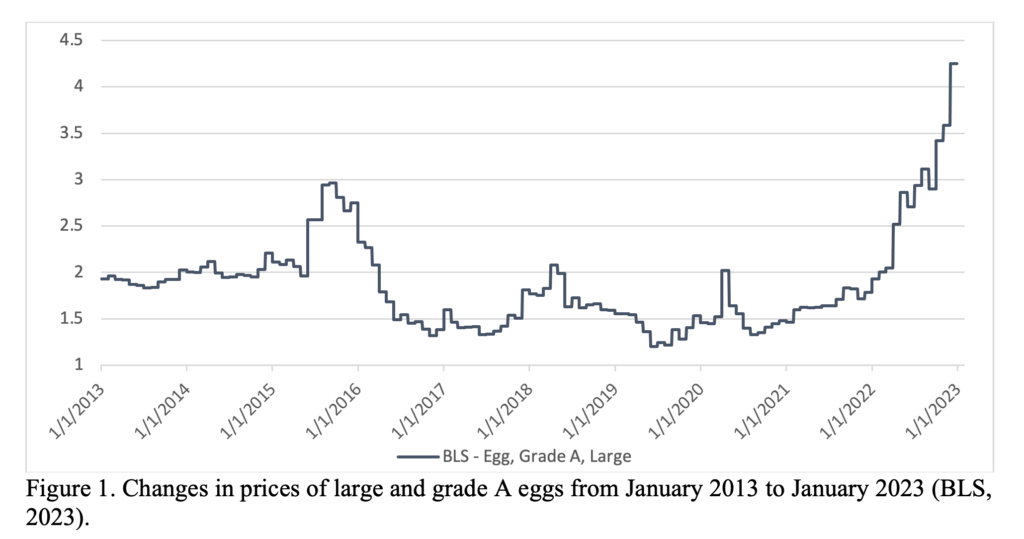
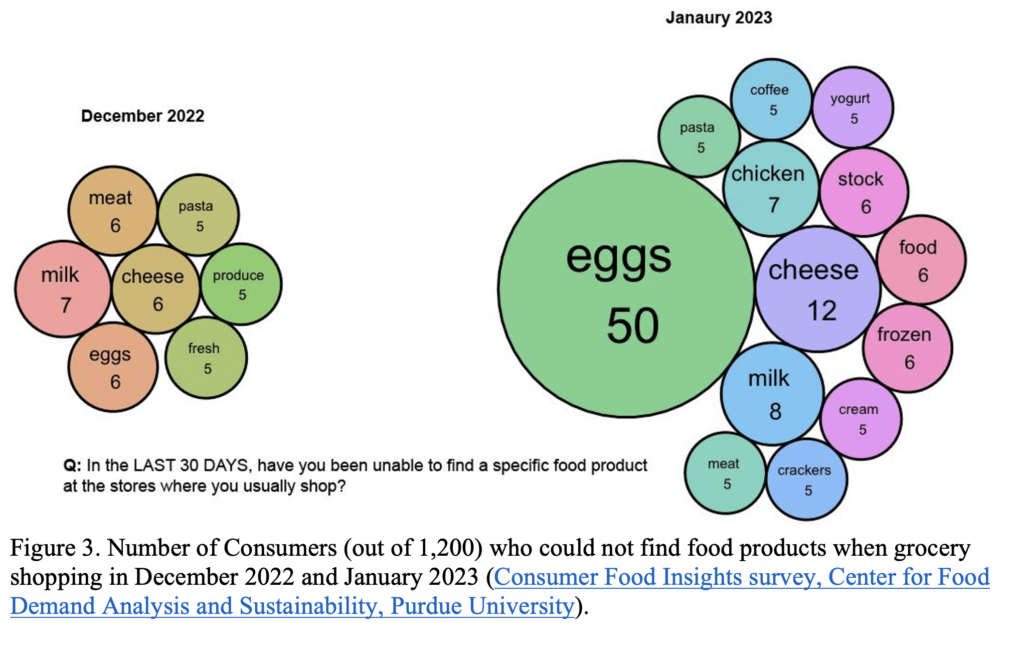
Egg prices have soared, hitting historically the highest level at $4.25 per dozen in 2022 (BLS, 2023). This is a 138% increase compared to December 2021, and the price spike exceeds the one experienced in 2015 when we last had a significant outbreak of Avian Influenza (Figure 1). The sudden rise in egg prices is creating a dent in household budgets for a couple of reasons: 1) U.S. households have increased consumption of eggs as a source of protein (USDA, 2022), and 2) egg demand is very inelastic. For example, a 1% price increase in the price of eggs would result in a 0.15% reduction in the quantity demanded by consumers (Lusk, 2023). Higher prices have also been accompanied with greater scarcity. The Center for Food Demand Analysis and Sustainability (CFDAS) at Purdue University conducts a monthly survey of over 1,200 consumers. From December 2022 to January 2023, there was a notable increase in the number of consumers who said they could not find eggs when grocery shopping (Figure 3).
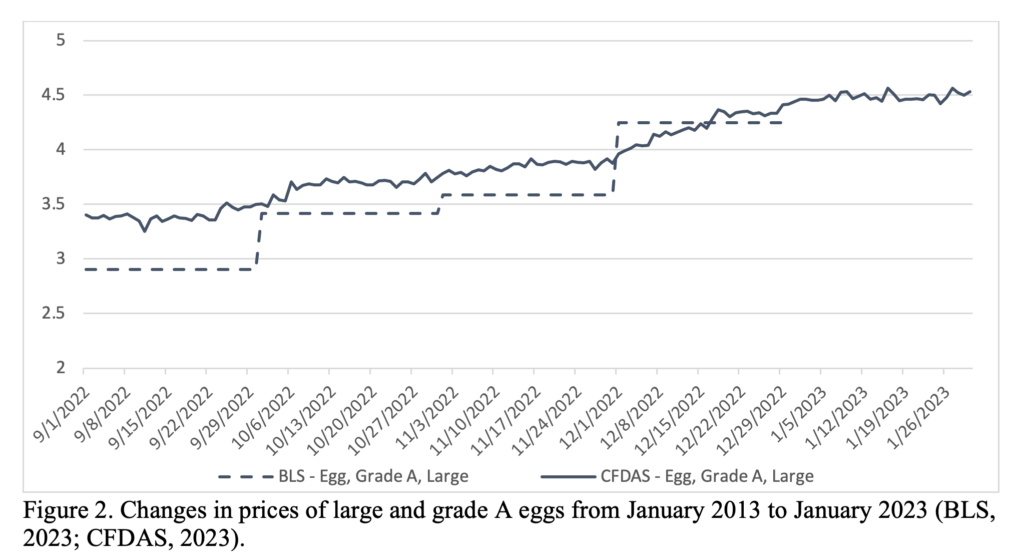
Given the rapidly rising prices reported in Figures 1 and 2, many are wondering when consumers can expect relief. Unfortunately, the Bureau of Labor Statistics (BLS), which collects and reports price changes as a part of its effort to track economy-wide inflation, reports prices with a significant lag. BLS’s monthly price measures come with about a two-week lag from the reference month to the date on which the index is released (that is, the Consumer Price Index for January is released in mid-February) due to its process of collecting and calculating such measures (BLS, 2020).
Fortunately, new methods and approaches can provide more timely information. The Center for Food Demand Analysis and Sustainability scrapes information on grocery items every day from 20 online grocery store chains across 48 states in the U.S. from September 2022. These data can be used to gain a more up-to-date look on what is currently happening with retail egg prices. Figure 2 illustrates a comparison of prices for a dozen large and grade A eggs between BLS and CFDAS. CFDAS presents daily variations, while BLS reports monthly averages. The two-price series moves closely together. Our more recent data shows egg prices reached a plateau in January. Given a decline in the wholesale price of a dozen of eggs in January (USDA, 2023), retail egg prices will hopefully drop soon albeit a lag between a drop in wholesale and retail prices.
ConsumerCorner.2023.Letter.07