

We spend a lot of time and effort discussing what to buy, but relatively little outward attention on what not to buy. (In transparency, we did spend time on this last month, so consider this our further-evolved conversation about not consuming.) We likely expend just as much – probably – emotional and intellectual energy on what not to buy. Do you stock up now? Do you need to purchase that today, next week, next month, or not at all? Or are most realistic purchase decisions (in the sense that you might actually buy the thing and can afford to do so) ultimately just temporal (now or later) decision?
For feasible purchases, it may be more a question of “when” than “if.” If you want a new bike, for example, and you can generally afford a bike within the context of an annual budget, then it may be a question of whether you make that expenditure today or wait a few months or a few years. Now, if you are on a bike budget and daydreaming about buying a yacht, that’s not a buy or no-buy decision anyway. Daydreams are not what we’re talking about when we think about conscious decisions about what not to buy. I mean, it’s fun, but it is not part of the emotional and intellectual energy expenditure of decision-making for most people. If you are legitimately conflicted about your upcoming yacht purchase decision, then I am not sure the concept of “no buy” is really something you are pondering concurrently.
We can think about budget constraints – our spendable money – in a variety of frameworks. We are told to make a budget, plan ahead, and consider the true costs of items: the cost to clean, maintain, repair, and actually use them. Boats and campers come to mind. People buy these things once, yes, but they pay for their continued use many times over in the form of time, energy, and money: repairs, cleaning, maintenance, insurance, storage. Budgets are useful for a variety of reasons. Almost everyone needs a budget to some degree, whether that means a formal, written, regularly updated document of some kind, or a vaguer understanding (less recommended, but common) of how much you have to spend.
Just like we did last month, and in the past when we explored your incredibly predictable pumpkin spice latte habit, we dug back into Google Trends data to learn about budgeting, and specifically, not buying. Recall that Google Search data are presented as “interest over time.” Specifically: “Numbers represent search interest relative to the highest point on the chart for the given region and time. A value of 100 is the peak popularity for the term. A value of 50 means that the term is half as popular. A score of 0 means there was not enough data for this term.”
Searches for “budget” are admittedly vague, and we have no way of determining which (or whose) budget you were interested in when you typed “budget” into the little bar of self-reflective truth. Admittedly, searches for “budget” may include references to government budget-cutting measures, as I suspect is at least partially the case in 2025.
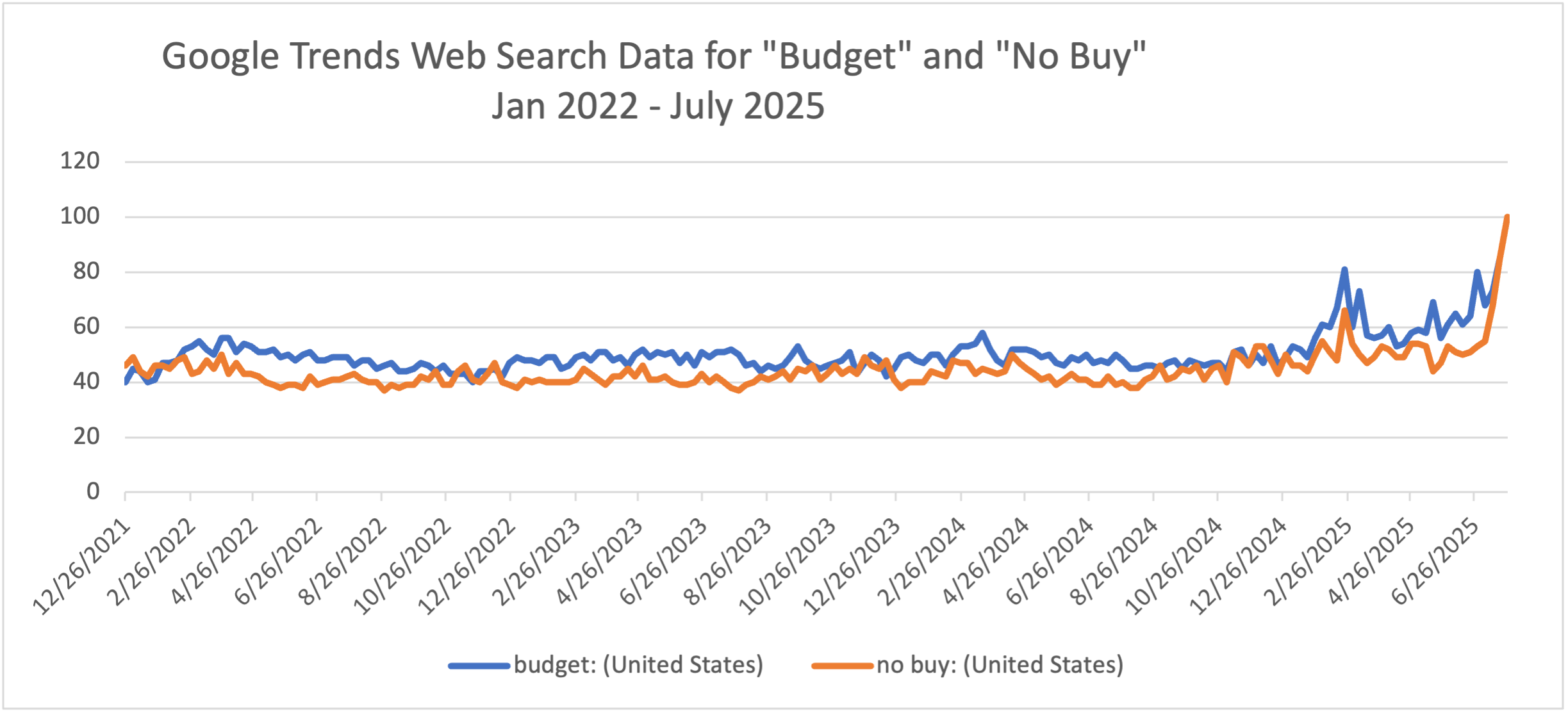
Budgeting is one thing. “No buy” is related, but it is much more specific: it focuses on what not to do, rather than where to allocate spending. A “no buy” is about not buying something for some set amount of time. The concept is flexible and one might see “No Buy July,” “No Buy January,” or a broader “no-buy challenge” where individuals stop purchasing nonessential items such as clothes, meals out, or other nonessentials. We wondered how closely searches for budgeting and “no buy” might mirror each other. When we compare searches for “no buy” with searches for “budget” the correlation is 0.79, indicating that these series tend to move together over the period studied (which we can also visually confirm).
“No buy” is generally less popular than “budget” in Google search interest. That makes sense given budgeting can mean many things and appears in many contexts, while “no buy” is quite specific. Yet interest in “no buy” moves upward in the latter portion of 2024 and into 2025. What was generally a low level of interest – peaking a bit in January and July – took off, still with New Year and mid-summer peaks, but at a higher baseline than in previous periods.
Not buying is clearly related to budgets, spending, and the allocation of financial resources. But are individuals driven solely by budgeting money? Or is there a growing acknowledgement of how “stuff” consumes resources, including time and attention? One can reasonably wonder whether “no buy” is driven solely by the desire to budget, or whether bigger societal questions at play here. Likely, it’s a little bit of both.