
Purdue Agribusiness Review, Volume 1, Issue 1
Why consumer pressure has become a leadership problem
Across food and agribusiness supply chains, from inputs at the farm gate to products on retail shelves, public pressure has intensified. What once involved navigating labor, environmental and regulatory requirements within a given geography now includes responding to consumer, public and even activist scrutiny over animal housing, genetically modified organisms, production practices, carbon claims and ingredient labeling, among other issues.
A common managerial reflex has been to respond with education. If consumers understood modern production systems, the logic goes, they would align with industry decisions. Industry groups have funded campaigns, coalitions have commissioned white papers and firms have invested heavily in messaging designed to explain how things “really work.” The underlying assumption is straightforward: if consumers knew what we know and thought like we think, they would agree with us.
This approach has not worked. Public discord persists, trust remains fragile, and new controversies continue to emerge.
Regardless of where firms are in the agribusiness supply chain, the end product eventually makes its way into consumer hands. Yet the consumer is often treated as a convenient explanation for market frustration. There’s much to be learned by consumer behavior. How should agribusiness leaders engage with, learn from, and respond to consumer demands – even when that behavior appears consistent, emotional or misaligned with industry logic?
The myth of “the consumer” and why it trips up good decision-making
Consumers are commonly vilified, but ultimately necessary. As we often say: Consumers – they’re fickle, they’re demanding, they’re (seemingly) uninformed. They’re you.
Several familiar but largely unproductive claims dominate conversations about consumers.
First, consumers don’t know what they want. This is true. Most people struggle to articulate future preferences. We are fine with our preferences changing when we’re the ones consuming but complain when we’re producing.
Second, consumers don’t understand our business. Also true – and understandable. It is not their business. Nobody wants to be forcibly educated and doing so about a product one is trying to sell can feel condescending at best and offensive at worst.
Third, the more dangerous claim: consumers don’t yet know they need. History offers successful products created before consumers explicitly demanded them, but those cases are rare. The fact that we all know who Steve Jobs is underscores how unique that capability really is. Understanding consumer needs and meeting them is fundamentally different from telling them what they should value.
A deeper misunderstanding lies in the idea that there is a single, coherent “consumer.” There is not. Individuals differ across tastes, preferences, values, income constraints and risk tolerance – and even within the same person, preferences change across time, place and circumstance. Few people welcome advertising or educational campaign designed to convince them to abandon favored brands or products. Only like a certain make of automobile? Why? Have an affinity for a certain color farm equipment? Most likely.
The challenge is not whether consumer behavior is messy. It is whether managers are willing to learn from it. There is no shortage of data. The real difficulty lies in deciding which questions are worth answering, how to interpret imperfect signals and how to overcome biases, legacy practices and organizational incentives that resist changing course.
What consumer behavior actually tells us – and what it doesn’t
The Consumer Corner series began online in the summer of 2020 with a simple goal: derive insights from everyday consumer behavior that could inform decisions from the farm to the marketplace. Over time, the series expanded into five years of articles and now a six-book collection exploring how people make choices.
Across the series, each volume deliberately builds on the last, moving from stated preferences to observed behavior, and from static snapshots to how expectations and sentiment evolve over time. The forthcoming sixth volume extends this work using foot-traffic data to compare where people actually go with what they say they intend to do.
The lesson is not that the data are scarce. It is that interpretation matters more than access. Across this body of work (Widmar, Smith, and Robinson, 2025a-d; 2026), several consistent insights emerge:
- Markets are dynamic and reflect expectations, beliefs, and social narratives – not just prices and quantities.
- Prices in the marketplace are determined by perceived value and scarcity and not by the cost to produce it.
- Social trust, or social license, is foundational and often taken for granted until it erodes.
- Preferences change over time, space, and circumstances; inconsistency is normal.
- Convenience carries real economic value.
- Online and social media sentiment data can capture unprompted opinions but is noisy, emotional, and volatile.
- Talk is cheap. Stated intentions frequently diverge from actual behavior.
- Trust is built through consistency, not persuasion or threat.
- Data reveals patterns, but only careful interpretation yields insight.
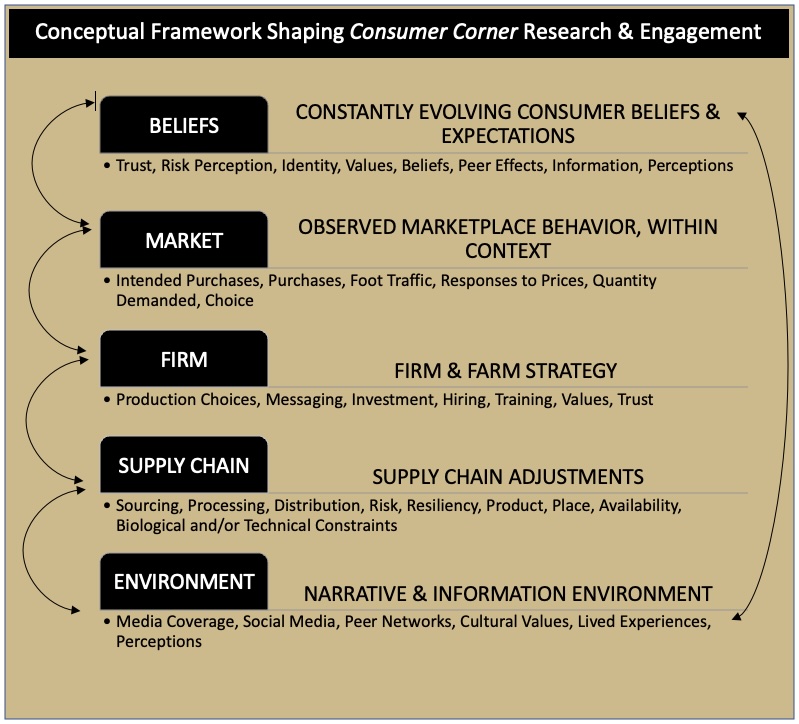
Consumers are not uninformed actors awaiting correction. They are individuals managing risk and optimizing household decisions while navigating time constraints, identity and values while making tradeoffs.
Leading in markets shaped by beliefs, not just prices
Although Consumer Corner focuses on consumers, its lessons ultimately fall heavily on managers responsible for navigating uncertainty and making strategic tradeoffs. If forcibly educating or convincing consumers is ineffective, what should leaders do differently?
First, invest deliberately in trust. Trust enables communication during crises and reduces the likelihood that public concern turns quickly into regulation.
Second, discipline the questions being asked. Not every interesting question is actionable. Distinguishing between insight and distraction is a managerial skill. As noted, elsewhere, asking “Why is a raven like a writing desk?” may be clever, but it rarely informs decisions (Widmar et al., 2025a).
Third, recognize that markets price expectations and beliefs, even when those beliefs are never fully realized. Monitoring narratives can be as important as monitoring fundamentals.
Fourth, separate understanding from agreement. Leaders do not need to endorse every viewpoint to learn from it, and attempting to change deeply held beliefs is often unproductive.
Finally, treat supply chains as resilient but not invulnerable. Preferences shift, goals move and uncertainty is persistent. Effective decision models account for volatility rather than assuming stability.
Managing trust, volatility and narrative risk
Consumers are not a defect in the system; they are the system. The cost of expressing opinions on social media or other platforms continues to fall, which means the likelihood of rapid reputational shocks are likely to continue and must be managed. While people may not always know what we want, they are often clear about whom they trust. What commands a premium today might become a liability tomorrow if trust erodes.
The true managerial risk is misdiagnoses. If leaders assume the problem is consumer ignorance, they may miss the core issues are trust and inherent or structural uncertainty. Agribusiness leaders do not manage around consumer inconsistency – they manage within it. The question cannot be how to correct the consumer. It is whether businesses are structured to absorb volatility in preferences, expectations and narratives without losing strategic direction.
After all: Consumers – they’re fickle, they’re demanding, they’re (seemingly) uninformed – they’re you!
Works Cited
Widmar, N. J., Smith, M. L., & Robinson, E., (2025). Consumer Corner: Consumer Lessons from a Pandemic. West Lafayette, Indiana: Purdue University Press.
Widmar, N. J., Smith, M. L., & Robinson, E., (2025). Consumer Corner: Decisions that Shape Supply Chains. West Lafayette, Indiana: Purdue University Press.
Widmar, N. J., Smith, M. L., & Robinson, E., (2025). Consumer Corner: Markets We Thought We Knew. West Lafayette, Indiana: Purdue University Press.
Widmar, N. J., Smith, M. L., & Robinson, E., (2025). Consumer Corner: Rethinking Consumer Data and Behavior. West Lafayette, Indiana: Purdue University Press.
Widmar, N. J., Smith, M. L., & Robinson, E., (2025). Consumer Corner: Market Signals from Online Behavior. West Lafayette, Indiana: Purdue University Press.
About the Center for Food and Agricultural Business
Founded in 1986, the Purdue University Center for Food and Agricultural Business is celebrating 40 years of working with the agribusiness industry to develop leaders and inform better decision-making. Housed within Purdue’s Department of Agricultural Economics, the center connects faculty expertise with the practical challenges facing food and agricultural companies.
The center delivers professional development programs, industry research and graduate education designed specifically for agribusiness professionals. Offerings include open-enrollment workshops, custom corporate training and the MS-MBA in Food and Agribusiness Management, a dual-degree program developed with industry for working professionals.
Through its research and publications – including the Purdue Agribusiness Review – the center shares industry insights from Purdue faculty and collaborators to help agribusiness leaders navigate change and make more informed strategic decisions.