Purdue Agribusiness Review, Volume 1, Issue 1
Where we are going and what it means
When most people hear “agriculture jobs,” they picture farms. The data tell a different story. In reality, more than 100,000 annual openings emerge across management, analytics, engineering, communications, policy and supply chain roles spanning the entire food and agriculture value chain. Yet fewer than half will be filled by graduates specifically trained in food and agriculture. The alignment between the jobs that exist and the talent prepared to fill them is a novel challenge for industry leaders.
In 1980, Purdue University and the U.S. Department of Agriculture launched a study of the demand for and supply of college graduates in the food, agriculture, renewable natural resources and environmental industries and majors. This study has been replicated roughly every five years, most recently with the release of Employment Opportunities for College Graduates in Food, Agriculture, Renewable Natural Resources, and the Environment – United States, 2025-2030 in October 2025. Bureau of Labor Statistics (BLS) job projections, adjusted with web-scraped data from Google Jobs, provide the demand estimates. Supply estimates are based on the National Center for Education Statistics (NCES) and its Integrated Postsecondary Education Data System (IPEDS) surveys.
This Purdue Agribusiness Review paper summarizes the results of the most recent Purdue-USDA employment opportunities report and highlights implications for food and agribusiness managers responsible for, or an interest in, human talent. (The full study is available here: https://www.purdue.edu/usda/employment/)
A structural workforce gap
Between 2025 and 2030, the food, agriculture, renewable natural resources and environment (FARNRE) sector will face a persistent and structural workforce tension: strong and sustained employment demand paired with an insufficient and uneven supply of graduates from colleges of agriculture prepared to fill available positions.
The central challenge is not a lack of employment opportunities. Rather, the issue is a mismatch between the volume and composition of available jobs and the pipeline of talent emerging from agricultural colleges.
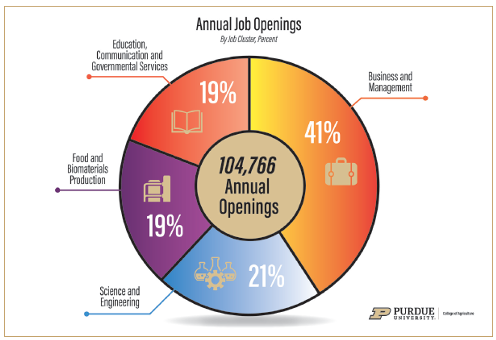
Our analysis indicates that the U.S. will average approximately 105,000 annual job openings across the FARNRE sector during the 2025–2030 period (Figure 1). These opportunities span the entire food and agriculture value chain, from input suppliers and production agriculture to supply chain, food processing and consumer-facing food retailing and marketing roles. Opportunities exist across managerial, communications, research, technical support, policy and education positions. Importantly, roughly 90% of these positions are expected to require at least an associate degree, underscoring the sector’s continued need for a technically trained workforce.
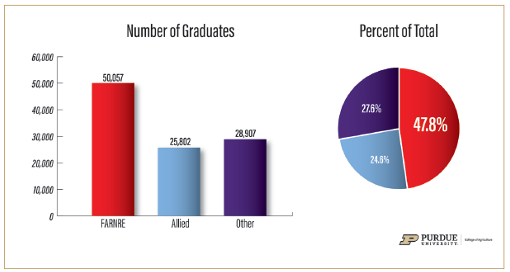
However, the projected annual supply of graduates specifically trained in food, agriculture, renewable natural resources and the environment from colleges of agriculture will fill only about 48% (50,057) of these positions (Figure 2). Another 25% (25,802) of the available FARNRE jobs will be filled by graduates from traditional allied majors, including engineering, life sciences, business and computer science. The remaining 28% of the jobs will need to be filled by graduates from other majors and by more allied graduates than have historically taken jobs in food and agriculture, with about 10% being filled by individuals with a high school diploma. The gap between the available FARNRE jobs and FARNRE graduates means that more than half of the talent entering the food and agricultural industries over the next five years will not hold a food and agriculture degree.
For industry leaders, this is the defining workforce issue for the next five years: not whether jobs will exist, but whether the right talent will be available in sufficient quantity and with the right mix of industry-specific, technical, managerial and digital skills.
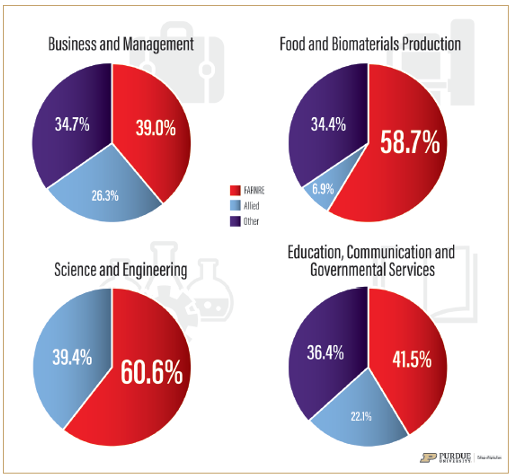
The tension is particularly acute in business and management roles, which represent the largest share of openings and also the category where the largest FARNRE graduate shortfall exists (Figure 3). Roughly 43,000 business and management jobs are forecast annually, with only 39% expected to be filled by FARNRE graduates.
Roughly 20,000-22,000 jobs will be available annually in the Science and Engineering, Food and Biomaterials Production, and Education, Communication and Governmental Services categories (Figure 3). About 60% of the Science and Engineering and Food and Biomaterials Production jobs will be filled by FARNRE graduates, while FARNRE graduates are expected to fill only 42% of Education, Communication and Governmental Services jobs (Figure 3).
In short, the industry is entering a period of sustained internal and external talent competition, in which other sectors recruit from the same pool of managerially astute, technically skilled and analytically capable graduates.
Why the talent gap persists
Despite decades of industry dialogue about the “war for talent,” labor dynamics in the FARNRE sector remain challenging for several reasons.
First, agriculture is no longer a niche labor market – and hasn’t been for some time. A common misconception is that “agriculture jobs” primarily refer to farm-level employment. In reality, the majority of openings are in management, sales, data analytics, supply chain, research and technical services across a complex and increasingly digitized value chain. The sector encompasses operations, finance, risk management, marketing and human resource management. These roles are mirrored in mainstream corporate environments as well as in policy, regulatory and global affairs, and within government and nonprofit sectors. Helping students understand the wide range of dynamic and impactful careers in the food and agriculture is not a new challenge, but it is a much more urgent one given the current talent market conditions.
Second, degree pathways are fluid. Graduates trained in agricultural fields frequently enter management, research, technical and supply chain roles, while graduates from allied majors such as business, engineering or science also compete for these positions. This blurring of boundaries complicates workforce forecasting and raises an important question: How important is a degree from a college of agriculture relative to a more general degree for employment in food and agricultural industries?
Third, hiring signals are evolving. Employer hiring practices are shifting toward skills-based hiring and broader applicant pools. Many job postings no longer explicitly require degrees, even when the work itself demands more advanced competencies. Where does an understanding of the food and agricultural sector fit in this evolving hiring landscape? These shifts create ambiguity in workforce data and can lead to an underestimating the sector’s true demand for talent with postsecondary credentials and industry knowledge.
Fourth, the sector competes with high-growth industries for talent. Graduates with business, data analytics, engineering and life sciences skills are highly mobile and can pursue careers in technology, healthcare, finance and consulting. Agriculture and food companies are increasingly competing with these industries for the same talent pool.
Finally, demographic and educational trends complicate supply. Declining numbers of high school graduates in some regions, falling college-going rates, evolving career preferences, fewer students with agricultural backgrounds and the growing appeal of nondegree credentials all introduce uncertainty into the future talent pipeline.
What we know
Demand will remain strong and diverse
The data indicate sustained and robust employment demand across four major job clusters: Business and Management; Science and Engineering; Food and Biomaterials Production; and Education, Communication, and Governmental Services.
Business and Management roles will continue to dominate, reflecting the increasing complexity of modern food and agribusiness systems and the need for talent in operations, finance, marketing, risk management, consulting and supply chain.
Science and Engineering positions will remain essential to innovation, particularly in digital agriculture, automation and robotics, genetics and genomics, food and nutrition science, and environmental management and sustainability. Employers are increasingly prioritizing expertise in AI, sensing technologies and data analytics as production and distribution systems digitize.
Food and Biomaterials Production roles will continue to demand sophisticated applied technical skills and hands-on experience, especially in agronomy, livestock management, food processing and bioenergy systems.
Meanwhile, demand for Education, Communication and Governmental Services roles will remain stable, driven by continued needs in policy, high school and university teaching, extension and science communication.
The talent gap is structural, not cyclical
The current pipeline of FARNRE graduates will not meet industry demand. Allied graduates from traditional fields will provide a large share of the workforce, yet a significant gap will remain that must be filled by graduates from other fields or nontraditional pathways.
The largest shortages are expected in business and management roles, government, education and communication positions, and specialized rural and technical roles that require agricultural backgrounds or are in rural areas.
Skills expectations are rising
Employer expectations consistently emphasize experience, critical thinking, problem solving, leadership, communication, teamwork, quantitative ability and data literacy. The growing emphasis on analytics signals a broader shift toward data-driven decision-making across the sector. Colleges of agriculture must prepare students for a work world that demands more. Given the need to recruit outside of FARNRE programs, employers will gravitate toward programs producing graduates best prepared for the workforce – wherever those programs are located.
Geographic distribution matters
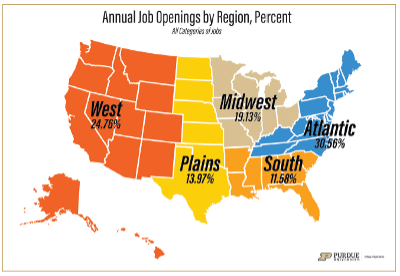
Job opportunities are not evenly distributed across regions, creating recruiting and relocation challenges for employers attempting to align talent with geographic demand (Figure 4). The Atlantic and West regions will account for more than half of the annual FARNRE job openings in the next five years. Employers may need to incentivize graduates from the Plains, Midwest and South regions to relocate to these regions.
What we don’t know (and must monitor)
Any forecast is based on assumptions about the future, and changes to those assumptions can alter projections. Key uncertainties include federal workforce policy changes, technological disruption, global market volatility, climate impacts, trade policy shifts and evolving credentialing models. The uptake and impact of artificial intelligence on human talent needs is especially important to monitor. Shifts and changes in any of these factors could reshape both the quantity and type of talent needed in the industry.
Managerial implications
Partnerships with educational institutions will become increasingly important, particularly in emerging areas such as automation, sustainability and digital agriculture. Industry can play an important role in helping FARNRE programs stay current with evolving talent needs. Companies can also work with educational institutions and youth development organizations such as FFA, 4-H and AFA to strengthen the talent pipeline.
Recruiting will need to become more strategic and proactive. Employers can no longer rely solely on traditional talent pipelines and should deepen engagement with a broader set of universities, community colleges and credentialing programs. Competition for FARNRE graduates will be intense. Most firms will need to recruit beyond traditional agricultural majors, including business, engineering, life science and data science programs.
The shortage of graduates from FARNRE programs means employers will need to convince graduates to move into any industry that food and agriculture can provide the career they are seeking. It also means employers will need to provide more industry-specific training in their onboarding programs, since fewer new hires will come with that preparation.
Employers should expect especially intense competition for specialized talent, including veterinarians, data-enabled agronomists, plant scientists, engineers and data analytics professionals.
Data analytics and digital skills are becoming core competencies. Entry-level employees are increasingly expected to contribute to analytics-driven decision-making and technology-enabled operations, and AI expertise is rapidly emerging as a foundational capability.
Workforce development should be treated as a strategic investment. Structured training, mentorship and early-career development programs will be critical for long-term talent sustainability, especially as industry shifts continue to redefine the role of a new hire.
Retention will become as important as recruiting. Replacing talent in a constrained labor market will become increasingly costly, and firms will likely compete aggressively for experienced talent within the industry.
What to watch going forward
Several developments could significantly influence the industry’s talent pipeline:
- Enrollment and graduate trends affecting talent availability, especially if fewer students pursue agriculture-related degrees.
- The evolution of skills-based hiring and alternative credentials and how it impacts entry-level recruitment.
- Advances in artificial intelligence, robotics, automation and digital platforms and how these developments change entry-level requirements.
- Demographic shifts and their impact on talent pipelines and organizational culture, especially as more positions are filled by graduates with little to no industry background.
- Government and policy developments affecting employment patterns, particularly in the public sector and regulatory and compliance roles.
- Global food system pressures, including population growth, sustainability expectations and climate variability – and their impact on sector health and demand for talent.
The 2025–2030 outlook for the FARNRE workforce is fundamentally a story of opportunity constrained by talent availability. Organizations that recognize the structural nature of this talent gap – and respond proactively with recruiting, skill development and strategic partnerships – will be best positioned to thrive in an increasingly complex, talent-constrained agri-food economy.
About the Center for Food and Agricultural Business
Founded in 1986, the Purdue University Center for Food and Agricultural Business is celebrating 40 years of working with the agribusiness industry to develop leaders and inform better decision-making. Housed within Purdue’s Department of Agricultural Economics, the center connects faculty expertise with the practical challenges facing food and agricultural companies.
The center delivers professional development programs, industry research and graduate education designed specifically for agribusiness professionals. Offerings include open-enrollment workshops, custom corporate training and the MS-MBA in Food and Agribusiness Management, a dual-degree program developed with industry for working professionals.
Through its research and publications – including the Purdue Agribusiness Review – the center shares industry insights from Purdue faculty and collaborators to help agribusiness leaders navigate change and make more informed strategic decisions.