
Purdue Agribusiness Review, Volume 1, Issue 2
The Problem: A cost that doesn't show up on any invoice
Every agribusiness executive understands tariffs. They have long been the most visible barrier to international trade. Even if they have recently returned to the political spotlight, their importance has declined over time as bilateral and regional trade agreements have reduced border barriers across much of the global economy, including agriculture. Yet many of the expected gains from tariff liberalization have not fully materialized. One reason is the proliferation of behind-the-border trade costs, particularly standards and technical regulations.
Standards exist for good reasons. In global supply chains, buyers often cannot observe how products are produced, and standards help close that information gap. They also introduce new complexities. Unlike tariffs, standards are less uniform across commodities and countries, and they are often difficult to observe and quantify, making them particularly consequential for day-to-day business operations.
The challenge for agribusinesses, however, is not simply that standards exist, but that they continue to diverge across countries, a phenomenon known as regulatory divergence. This occurs when standards and technical requirements for the same product differ across markets. This applies to crop protection products and agricultural production itself. As major import and export markets adopt increasingly different rules on pesticides, sustainability, traceability and production methods, agribusiness firms no longer navigate a single global trading system. Instead, they source and supply across regulatory regimes that compete on quality and process, not on price.
This means that even as tariffs have fallen, global sourcing has, in many ways, become more difficult. When standards in a supplier’s country differ from those in the destination market, costs arise long before a shipment leaves the port. Foreign suppliers must adapt production processes, document compliance and navigate inspections. Importing firms must identify compliant suppliers, monitor regulatory changes and manage the risks of shipment rejection and reputational damage. None of these costs appear on an invoice. They accumulate through compliance departments, testing procedures, delayed shipments, supplier screening and disrupted sourcing relationships.
Why regulatory divergence is easy to underestimate
It blends legitimate regulation with hidden protectionism.
Unlike tariffs, standards do not discriminate against foreign firms by design. Many pursue legitimate public objectives, including food safety, environmental protection, traceability and sustainability. They help ensure buyers can trust what they are purchasing. At the same time, regulations can disguise protectionist intent. In practice, separating public-interest motives from protectionist ones is difficult because both can coexist within the same measure. This means that the standard assumption that trade liberalization improves welfare does not automatically extend to standards and regulations.
It is difficult to observe and quantify.
Regulatory fragmentation is difficult to measure and therefore easy to underestimate. Tariffs are transparent and straightforward to incorporate into sourcing models. Regulatory divergence is not. Firms may know that a rule exists, but comparing the relative stringency of regulations across countries is far more complicated.
Two markets may regulate the same criterion differently, generating compliance burdens that standard trade metrics fail to capture. The effects are also diffuse. A tariff change creates a visible before-and-after shock in procurement data. Regulatory divergence rarely does. Instead, its effects accumulate gradually. Firms reduce orders, substitute suppliers, narrow product ranges or quietly redirect sourcing strategies without explicitly attributing these adjustments to compliance costs.
It widens over time and across markets.
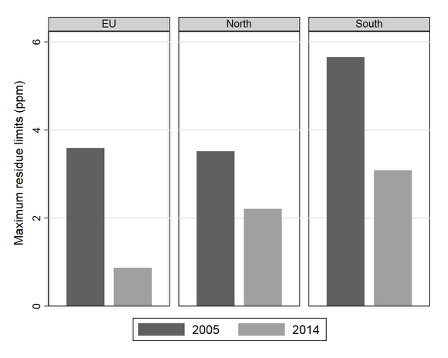
Regulatory divergence is not static, and it does not respect a simple North–South divide. Standards in major importing markets have generally become stricter over time, increasing the compliance gap between importing and exporting countries. For many agricultural products, residue limits permitted in the mid-2000s were substantially reduced by the mid-2010s. Significant differences also persist between advanced economies, as recurring transatlantic disputes over chlorinated chicken, hormone-treated beef and genetically modified organisms illustrate. For agribusiness firms with global sourcing networks, regulatory divergence is likely to widen further in the coming years.
It reshapes market structure.
Rising compliance costs disproportionately disadvantage smaller and less productive suppliers. The firms that remain are typically larger, better capitalized and better able to absorb the fixed costs of certification, testing, traceability and regulatory monitoring. This reduces supplier diversity and increases dependence on a smaller pool of compliant exporters, making supply chains more vulnerable to disruption. Regulatory divergence does more than alter trade flows. It changes which suppliers survive and how global agribusiness markets are organized.
Figure 1. Average MRLs by importing country groups
What the evidence shows
In Fiankor, Dalheimer, and Mack (2025), we examine these dynamics using firm-level Swiss customs transaction data combined with country-product-year-specific maximum residue limit (MRL) data for pesticides. Switzerland offers a useful setting because it is a small, open agrifood economy that depends heavily on food imports and remains deeply integrated into European value chains while operating outside the EU. This allows us to observe how importing firms across the size and productivity spectrum respond to differences in regulatory standards across source countries. Our customs data cover more than 10,000 importing firms, 255 product categories and 65 source countries between 2016 and 2018.
While the analysis focuses on Switzerland, the underlying mechanisms apply to any agribusiness firm navigating differing standards across source markets.
One of the major challenges in studying non-tariff measures is that regulatory stringency is difficult to compare across countries. Pesticide MRLs help overcome this problem because they are continuous, product-specific, and directly comparable across markets. Lower permitted residue levels indicate stricter standards. For example, the EU permits a maximum residue level of 0.01 mg/kg for Carbaryl in mandarins, while the United States allows 10 mg/kg – a thousand-fold difference for the same product. MRLs, therefore, provide a transparent metric for quantifying regulatory divergence. Table 1 illustrates how MRLs vary across countries for selected active substances and crops (values in mg/kg).
Pesticides are also strategically relevant because they sit at the center of tensions among agricultural productivity, food safety, environmental sustainability and public health. Modern agriculture depends heavily on pesticides, yet concerns over groundwater contamination, biodiversity loss, pollinator decline and human health risks have intensified political pressure for stricter regulation. At the same time, regulatory trajectories across markets continue to diverge.
A one-standard-deviation increase in our MRL index reduces firm-product-level imports by about 18 percent. Firms rarely abandon sourcing relationships altogether. Instead, they import less from affected suppliers over time. Supplier networks may appear stable on the surface while sourcing volumes contract. These shifts often escape standard procurement reviews, which tend to track whether supplier relationships exist rather than how volumes within them are evolving.
Table 1. How MRLs vary across countries for selected active substances and crops (values in mg/kg)
Active substance | Product | Switzerland | EU | Japan | USA | Canada | China | Codex |
Carbaryl | Mandarins | 0.01 | 0.01 | 7 | 10 | 10 | – | 15 |
Captan | Apples | 3 | 10 | 5 | 25 | 5 | 15 | 15 |
Fenbutatin-oxide | Apples | 2 | 2 | 5 | 15 | 3 | 5 | 5 |
Acetamiprid | Apples | 0.8 | 0.8 | 2 | 1 | 1 | 0.8 | 0.8 |
Azoxystrobin | Tomatoes | 3 | 3 | 3 | 0.2 | 0.2 | 3 | 3 |
Folpet | Avocado | 0.02 | 0.03 | 30 | 25 | 25 | – | – |
Several findings are strategically important:
The tariff-equivalent effect is economically large. A one-standard-deviation increase in regulatory divergence between Switzerland and a source country reduces firm-level import values by roughly 18 percent. Expressed as an ad valorem tariff equivalent, this corresponds to approximately 24 percent, comparable in magnitude to tariff barriers large enough to provoke formal trade disputes. The cost is very real. It is simply embedded in compliance systems, sourcing frictions, testing requirements and procurement costs rather than appearing explicitly at the border.
GVC participation buffers the effect. Firms that both import and export are significantly more resilient to regulatory divergence than import-only firms. The same increase in regulatory divergence generates a trade-reduction effect that is roughly 5 percentage points smaller for these firms. The likely mechanism is organizational learning. Firms already familiar with foreign export standards have built internal expertise in certification, traceability and regulatory monitoring, and that expertise carries over to the import side.
Firm size matters. Larger firms cope better with regulatory divergence than smaller ones. The same shock reduces trade flows by 24 percent for small firms, 17 percent for medium-sized firms and 12 percent for large firms. Large firms can sustain specialized compliance teams and exploit returns to scale in sourcing operations.
It induces price effects. The decline in imports does not primarily reflect firms seamlessly switching to cheaper suppliers elsewhere. Instead, firms often import fewer units at higher prices. This matters because regulatory divergence operates not only as a trade barrier but also as a source of upstream cost inflation. Compliance costs, certification requirements, testing procedures and sourcing constraints gradually pass through into procurement prices, eroding some of the cost advantages that originally motivated offshore sourcing strategies.
Diversification reduces vulnerability. Firms sourcing from multiple countries or operating across a broader range of product categories are better able to absorb regulatory shocks than firms dependent on a narrow supplier or product base. Importantly, this effect persists even after accounting for firm size. The implication is that resilience does not emerge simply because large firms diversify. Diversification itself functions as an organizational hedge against regulatory fragmentation, although potentially at the expense of some scale efficiencies.
Harmonization generates sizable trade gains. Simulation exercises show that even partial regulatory harmonization can generate substantial increases in trade. Reducing regulatory differences between Switzerland and its trading partners significantly raises import flows, particularly where initial compliance gaps are largest. Importantly, the gains do not require eliminating standards altogether. Rather, trade expands when countries adopt more compatible rules, clearer equivalence frameworks or mutual recognition arrangements. A meaningful share of current sourcing frictions is policy-induced and potentially reversible through greater regulatory coordination.
These findings extend beyond Switzerland or pesticide regulation. The same logic applies whenever standards diverge meaningfully across countries.
Managerial implications for agribusiness firms
These findings do not point to a single right strategy. Rather, they surface a set of tradeoffs that deserve more deliberate attention in sourcing strategy, supplier management and firm structure than most agribusiness organizations currently give them.
Map regulatory exposure. Most procurement functions track tariff exposure with reasonable precision. Far fewer have mapped their sourcing portfolio against regulatory divergence across source countries. This is a gap worth closing. For each major input category, three questions are worth asking: Where does the source country’s regulatory standard sit relative to the home market? How frequently does it change? Which product categories are most sensitive to divergence, particularly differentiated products where regulatory gaps tend to be amplified? The answer is not always to shift sourcing, but it should inform how much investment in a supplier relationship is warranted and where backup options are worth maintaining.
Treat compliance capability as a sourcing asset. Firms that have built rigorous systems for meeting export destination standards possess organizational capabilities that directly reduce the cost of meeting import standards at home. Firms that treat compliance purely as overhead miss this. The institutional knowledge accumulated in managing export regulations is transferable to the import side.
Diversification has a regulatory rationale, not just a supply-risk rationale. The case for supplier diversification as a hedge against concentration risk is well established.The regulatory evidence adds a seconddimension: diversification across source countries and product categories also reduces exposure to any single country’s regulatory trajectory. As major importing markets tighten standards – and evidence suggests Europe is not unique in this direction – the cost of mono-origin sourcing strategies will rise. But diversification is not free. It reduces economies of scale and increases coordination costs. Firms that have not priced regulatory risk into their sourcing models are systematically undervaluing diversification.
Size confers advantages that cannot be fully delegated. Large importing firms cope better with regulatory divergence because they can sustain specialized compliance teams, absorb higher fixed costs. Mid-sized firms can narrow the gap by joining industry consortia that pool regulatory intelligence, investing in systems that track requirements by origin and product, and maintaining a deliberately broader sourcing network, even at a modest scale premium. Regulatory capability is partly about scale, but it is also about deliberate investment.
What to watch
Several developments are likely to make regulatory divergence more important over the next five to ten years.
European and global regulatory tightening are moving in the same direction. The EU’s Farm to Fork targets, national pesticide initiatives in member states and parallel regulatory tightening in other major markets represent an upward trajectory in the standards that supplying firms will need to meet. At the same time, regulatory alignment between major trading blocs has stalled or reversed since 2016. The US, EU and major Asian economies are pursuing divergent trajectories on food safety, environmental standards and chemical regulations. For agribusiness firms with global sourcing networks, the number of regulatory divergences in their portfolio is likely to grow, not shrink.
Harmonization remains elusive but worth monitoring selectively. Full multilateral harmonization is politically unrealistic in the near term. Bilateral and regional regulatory equivalence agreements, similar to the sanitary and phytosanitary provisions in trade agreements, are more achievable. Firms whose supply chains align with active trade negotiation corridors should track these developments. As our Swiss-EU harmonization simulation suggests, equivalence agreements can substantially improve the economics of existing sourcing relationships.
Digital traceability infrastructure. One structural reason small firms are disadvantaged in managing regulatory divergence is the fixed cost of acquiring and maintaining compliance information across multiple source countries and product categories. Emerging traceability platforms, industry-level MRL databases and blockchain-based certification systems are beginning to reduce this fixed cost. Firms that adopt these tools early may be able to operate with a regulatory resilience profile closer to large firms than their scale would otherwise allow. The technology does not eliminate the cost of divergence. It redistributes it in ways that could alter competitive dynamics in procurement.
Making regulatory divergence a strategic issue
Regulatory divergence reduces firm-level imports, raises prices and reshapes which firms can compete in global markets. The effects are economically large, equivalent in our setting to a 24 percent tariff, yet they remain invisible in standard procurement reviews. Firms that have built compliance capacity through GVC participation, diversified across origins and products, and invested in regulatory monitoring are better positioned to absorb these shocks. As major importing markets continue to tighten their standards, treating regulatory divergence as a first-order strategic concern, rather than a compliance afterthought, will become increasingly important.
About the Center for Food and Agricultural Business
Founded in 1986, the Purdue University Center for Food and Agricultural Business is celebrating 40 years of working with the agribusiness industry to develop leaders and inform better decision-making. Housed within Purdue’s Department of Agricultural Economics, the center connects faculty expertise with the practical challenges facing food and agricultural companies.
The center delivers professional development programs, industry research and graduate education designed specifically for agribusiness professionals. Offerings include open-enrollment workshops, custom corporate training and the MS-MBA in Food and Agribusiness Management, a dual-degree program developed with industry for working professionals.
Through its research and publications – including the Purdue Agribusiness Review – the center shares industry insights from Purdue faculty and collaborators to help agribusiness leaders navigate change and make more informed strategic decisions.