Purdue Agribusiness Review, Volume 1, Issue 3
The challenge
For six decades, the eradication of New World Screwworm (NWS) stood as one of the greatest animal health successes in the United States. After its eradication in 1966, a sterile fly release program and biological barrier in Panama kept the parasite from returning to North America. As a result, U.S. cattle producers rarely viewed NWS as an immediate production or trade threat (Congressional Research Service, 2025).
That changed in 2023 when NWS breached the biological barrier and spread through Central America and Mexico. As the outbreak advanced during 2024 and 2025, the U.S. Department of Agriculture (USDA) suspended imports of live cattle, horses and bison from Mexico while expanding surveillance along the southern border (USDA APHIS, 2025). When the first U.S. case was confirmed in June 2026, NWS shifted from a potential threat to an active animal health challenge. Policymakers and industry leaders suddenly faced difficult decisions about trade, cattle movement and eradication while trying to limit further economic damage.
The NWS response illustrates a broader challenge for agricultural biosecurity. Biosecurity policies often impose immediate, visible costs while delivering benefits that are uncertain and difficult to measure. Import restrictions disrupt supply chains, reduce feeder cattle availability and raise procurement costs. Surveillance and eradication programs also require substantial public investment. Yet their benefits are largely invisible. When disease spreads more slowly or causes less damage, no one can directly observe the losses that never occurred.
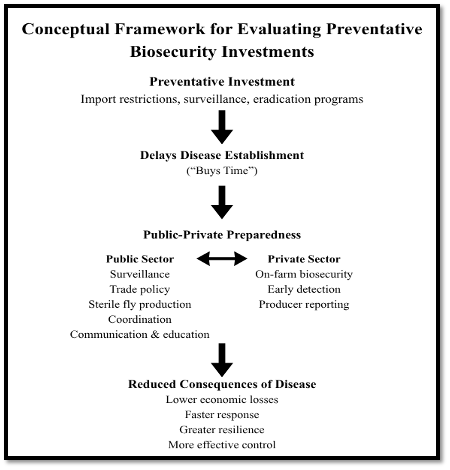
This imbalance makes biosecurity policies difficult to evaluate. Too often, they are judged only by whether they keep disease out. But many interventions also serve another purpose: buying time. Delaying disease establishment gives governments and industry leaders time to strengthen surveillance, expand response capacity, coordinate resources and prepare for an outbreak. From this perspective, the value of biosecurity lies not only in preventing disease but also in reducing its consequences.
As livestock diseases and invasive pests continue to threaten U.S. agriculture, policymakers will increasingly need to weigh the immediate costs of preventive action against the economic value of buying time. Developing a framework to evaluate those tradeoffs will lead to better biosecurity decisions.
Why this is hard
Estimating the costs of a New World Screwworm outbreak is challenging, but estimating the value of preventing one is even harder. Policymakers must decide whether to invest in biosecurity before they know how a disease will spread, how markets will respond or how effective control efforts will be.
Part of the challenge is that biosecurity costs and benefits occur on different timelines. Import restrictions, surveillance and eradication efforts require immediate spending and often disrupt markets. Border closures reduce feeder cattle imports, tighten domestic supplies and raise costs for feedlots. These costs are visible and can usually be measured within days or weeks.
The benefits are much harder to measure because they depend on events that never happen. When biosecurity slows disease spread, policymakers must estimate the losses they avoided rather than the losses they observed. Even if a disease eventually crosses the border, earlier interventions may still have delayed its arrival or reduced its spread. Judging policy only by the final outcome overlooks the value of that delay.
Biosecurity policies also affect different groups in different ways. Cow-calf producers may benefit from higher feeder cattle prices, while feedlots face higher input costs. Consumers may pay more for beef, and government agencies must balance those economic effects against their responsibility to protect animal health. A policy that benefits one group may impose costs on another, making consensus difficult.
Most businesses routinely invest in insurance, cybersecurity and emergency preparedness even though none of these eliminate risk completely. Instead, they reduce potential losses and improve an organization’s ability to respond. Biosecurity serves the same purpose. Yet it is often judged by a higher standard: whether it prevents disease entirely rather than whether it reduces damages and improves preparedness.
Effective biosecurity decisions require balancing immediate, measurable costs against uncertain future benefits.
What the evidence shows
Researchers have documented the biological threat posed by New World Screwworm for decades, but far less attention has focused on the economics of preventing or delaying its spread. That gap matters because policymakers must decide whether the benefits of border closures, surveillance and eradication efforts justify their immediate costs.
Recent events show that preventive measures can impose significant costs long before disease becomes established. After the U.S. suspended live cattle imports from Mexico, feeder cattle supply tightened and prices rose as buyers competed for fewer available animals (Sumner et al., 2026). Because Mexican imports had supplied roughly 3% to 4% of U.S. feeder cattle demand, those market responses were expected (USDA ERS, 2026; USDA NASS, 2026). The costs were immediate and easy to observe.
The benefits are much harder to measure. Border closures create time for agencies to strengthen surveillance, expand sterile insect production, improve coordination and help producers prepare for an outbreak. Although no one can directly measure the losses avoided, those efforts can reduce the economic damage once disease arrives.
Before New World Screwworm was detected in the United States, we asked a simple question: How much delay would border restrictions need to create to justify their costs? Rather than treating border closures as either a success or a failure, we evaluated them as an investment in buying time to prepare.
The answer suggests that time has substantial economic value. Under a scenario in which endemic NWS causes $10 billion in annual losses, border restrictions would need to delay establishment by about 4.2 months for every month the border remained closed to offset their costs.
The first confirmed U.S. case in June 2026 does not change that conclusion. Border restrictions were never guaranteed to prevent NWS permanently. Their value depends on whether the additional time improved preparedness and reduced the damages that followed.
Important uncertainties remain. No one yet knows how widely NWS will spread or how successful current eradication efforts will be. But one lesson is already clear: biosecurity policies should be judged not only by whether disease crosses the border, but also by the value of the time they create.
Managerial implications
The response to New World Screwworm suggests that biosecurity policies should be evaluated as risk-management investments rather than guarantees of disease exclusion. Border closures, surveillance programs and eradication efforts cannot eliminate every threat. Instead, they reduce risk by delaying disease establishment, improving preparedness and limiting long-term economic losses.
The value of delaying disease depends on how that time is used. Government agencies, industry organizations and producers can strengthen surveillance, expand eradication capacity, improve communication and enhance on-farm biosecurity. These investments increase the value of prevention by reducing the economic and operational consequences of an outbreak. If the time is not used to improve preparedness, much of its value is lost.
Figure 1 provides a framework for assessing preventative biosecurity investments. Preventive measures create value by buying time to prepare, but that value depends on coordinated action across the public and private sectors. Government agencies, industry organizations and producers each contribute different capabilities, and the benefits of delaying disease establishment increase when those efforts reinforce one another.
Biosecurity policies also affect different parts of the livestock industry in different ways. Import restrictions, movement controls and disease surveillance do not affect every stakeholder equally. Cow-calf producers, feedlots, processors, consumers and government agencies each experience different costs and benefits. Policymakers should therefore evaluate biosecurity measures based on their effects on the resilience and long-term performance of the industry as a whole rather than on the impacts experienced by any single group.
Finally, policymakers should avoid viewing biosecurity decisions as simple successes or failures. Disease outbreaks result from many biological, environmental and operational factors beyond the control of any single intervention. If a disease eventually reaches the United States, it does not necessarily mean earlier preventive efforts failed. Likewise, the absence of disease does not prove those investments were unnecessary. Successful risk management often reduces the severity of an outbreak rather than preventing it entirely.
What to watch going forward
The confirmation of NWS in the United States shows that biosecurity is not a one-time decision but an ongoing process. Although the initial response has focused on surveillance, movement restrictions and containment, its long-term success will depend on how industry and policymakers respond in the months and years ahead. Recent detections should be viewed not as the end of a prevention strategy, but as the beginning of a longer effort to limit the pest’s spread and reduce its economic impact.
One of the most important indicators to watch is the geographic spread of future NWS detections. Isolated cases that are identified quickly and contained present a much different challenge than widespread establishment across major livestock-producing regions. Continued investment in surveillance, rapid response and sterile insect production will play a critical role in determining whether future outbreaks remain localized or spread more broadly.
Trade policy will also continue to evolve. Import restrictions may remain an important part of the national response, but policymakers will need to balance the risk of disease spread against the economic costs imposed on producers, feedlots and consumers. As more information becomes available, they will need to reassess whether existing restrictions remain appropriate.
The broader lesson extends beyond New World Screwworm. Globalization, climate variability and the movement of animals and animal products continue to increase the risk of transboundary diseases and invasive pests.
Ultimately, biosecurity should not be judged solely by whether disease is prevented indefinitely. A better measure of success is whether preventive investments improve preparedness, strengthen response capacity and reduce long-term damage. The decisions made today will shape not only the response to New World Screwworm but also the resilience of the U.S. livestock industry in the years ahead.
References
Congressional Research Service. 2025. New World Screwworm: Current Issues. https://www.congress.gov/crs_external_products/IN/PDF/IN12558/IN12558.1.pdf
Sumner, S.A., S. Jones, T. Islam, and K.A. Schaefer. 2026. “Delaying the Inevitable? U.S. Screwworm Closures and Feeder Cattle Market Dynamics.” Applied Economic Perspectives and Policy. https://doi.org/10.1002/aepp.70111
U.S. Department of Agriculture, Animal and Plant Health Inspection Service. 2025. UPDATE: Import Alert: New World Screwworm Restrictions for Live Animals Originating from or Transiting Mexico. https://www.aphis.usda.gov/sites/default/files/import-alert-nws-mexico.pdf
U.S. Department of Agriculture, Economic Research Service. 2026. Cattle: annual and cumulative year-to-date U.S. trade (head). https://www.ers.usda.gov/media/5599/cattle-annual-and-cumulative-year-to-date-us-trade-head.xlsx?v=38762
U.S. Department of Agriculture, National Agricultural Statistics Service. 2026. Statistics by Subject: National Statistics for Cattle. https://www.nass.usda.gov/Statistics_by_Subject/result.php?146C9CB5-A64F-3BC1-9628-CCAD955F4913§or=ANIMALS%20%26%20PRODUCTS&group=LIVESTOCK&comm=CATTLE
About the Center for Food and Agricultural Business
Founded in 1986, the Purdue University Center for Food and Agricultural Business is celebrating 40 years of working with the agribusiness industry to develop leaders and inform better decision-making. Housed within Purdue’s Department of Agricultural Economics, the center connects faculty expertise with the practical challenges facing food and agricultural companies.
The center delivers professional development programs, industry research and graduate education designed specifically for agribusiness professionals. Offerings include open-enrollment workshops, custom corporate training and the MS-MBA in Food and Agribusiness Management, a dual-degree program developed with industry for working professionals.
Through its research and publications – including the Purdue Agribusiness Review – the center shares industry insights from Purdue faculty and collaborators to help agribusiness leaders navigate change and make more informed strategic decisions.