
Purdue Agribusiness Review, Volume 1, Issue 3
The context
Family businesses are a significant contributor to the economic engine of the United States. In 2021 they accounted for over half of GDP, and almost 60% of total employment.[1] Family businesses are even more pronounced in production agriculture: According to the USDA’s 2022 Census of Agriculture, 95% of U.S. farms are family-owned, and family farms account for 81% of total U.S. agricultural production value.
The leaders of our nation’s farms and ranches are growing older. In that same 2022 Census of Agriculture data, approximately 63% of farmers were over age 55.[2] Even considering industry consolidation – that as farms grow, you need fewer younger farmers to replace the aging ones – the number of new farmers needed to replace those retiring is concerning. The odds that a successor will be identified, and that a successful transition will take place, appear challenging for many family farms and ranches today.
The demographics paint a concerning picture, and that’s before you consider family business succession statistics. Studies over the years have suggested that a small percentage of family businesses successfully transition through multiple generations.[3] More recently, in a 2026 survey of 300 family business executives, Deloitte researchers found “an overwhelming 85% of respondents recognize that CEO succession planning is essential for long-term success, and 42% expect a leadership transition within just three to five years. Yet only 23% have actively implemented a plan to address it.”[4] Yet succession planning remains limited among many of the businesses that need it most.
The anecdotal evidence is not much better. Across rural communities, fewer family farms and ranches survive the generational handoff. In many cases, the younger generation does not return. In other cases, poor communication and difficult family dynamics derail the transition, leaving many farms and ranches absorbed, sold, split or tied up in inheritance disputes.
[1]Pieper, T.M., Kellermanns, F.W., & Astrachan, J.H. (2021). Update 2021: Family Businesses’ Contribution to the U.S. Economy. University of North Carolina at Charlotte & Kennesaw State University.
[2] 2022 Census of Agriculture, US Data, Table 52
[3] Craig E. Aronoff, “Family Business Survival: Understanding the Statistics,” The Family Business Advisor, The Family Business Consulting Group, Inc. Available at: https://www.thefbcg.com/wp-content/uploads/2021/06/FBA_Family-Business-Survival-Understanding-the-Statistics_CA.pdf
[4] Deloitte Private, “Survey Reveals Family Businesses Are Facing a ‘Succession Paradox,'” Deloitte, 2026. https://www.deloitte.com/us/en/about/press-room/deloitte-private-survey-reveals-family-businesses-are-facing-a-succession-paradox.html
The challenges
One reason succession is difficult is definitional. “Succession” can mean transferring assets such as land, equipment or livestock, or it could mean transferring the management skills and responsibilities required to run the business. Those are related transitions, but they are not the same.
Both assets and management capability must transition to the next generation. Asset ownership can transfer through a sale, lifetime gift or inheritance, typically using estate-planning tools such as wills and trusts.
Management capability transfers differently: through teaching, mentoring, practice, trial and error and sometimes trial by fire. These transitions also occur among family members who bring years of relationship history and family dynamics into the business.
Family members and business participants are simultaneously wearing multiple hats. Overlapping roles create conflict and confusion, often making it difficult to plan or converse around distinct topics. The result can be misunderstanding and heated arguments; at other times, people simply become frustrated and stop communicating with each other.
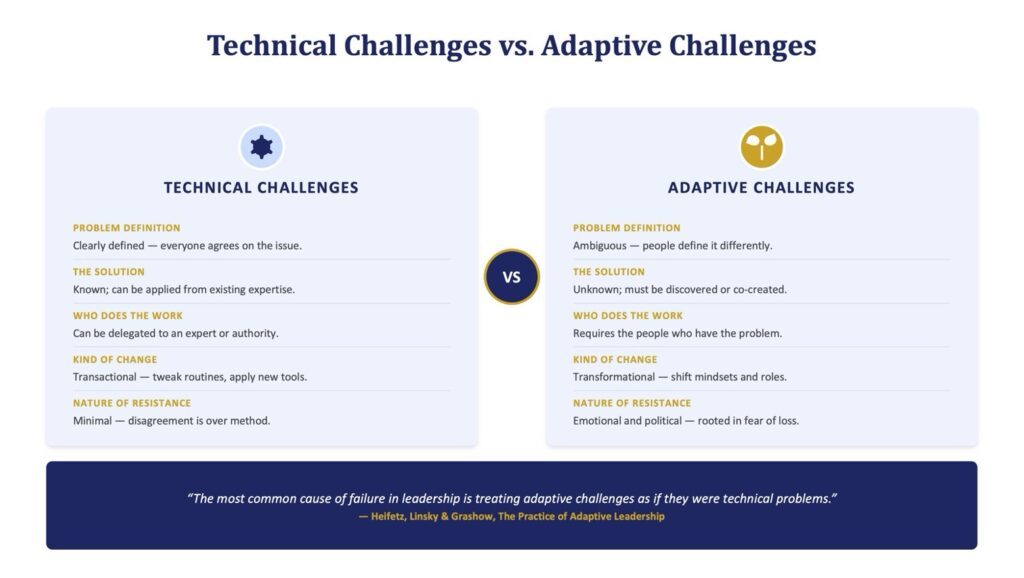
A second reason succession is difficult is that ownership and management transitions require different problem-solving approaches. Dr. Ronald Heifetz and Dr. Marty Linsky distinguish between “technical” problems, which have known solutions that expertise can address, and “adaptive” challenges, which require people to change values, beliefs or habits.[1]
Applied to family agriculture business, ownership transitions are largely technical. Accountants and attorneys can draft documents and implement the legal structures that move assets from one generation to the next. Those plans still require periodic review, and they cannot eliminate family conflict, but the tools and expertise to execute them are generally known.
Management transitions are adaptive. The senior generation must transfer knowledge and step back while the next generation develops the skills, confidence, judgement and leadership capacity to step forward. Outside experts can help facilitate that work, but they cannot do it for the family. The people in the business must make the transition themselves.
[1] Ronald A. Heifetz and Marty Linsky, Leadership on the Line: Staying Alive through the Dangers of Leading. Boston: Harvard Business School Press, 2002.
A third reason succession is difficult is that the business doesn’t stand still; it is growing and evolving while one is trying to figure out succession. It’s like trying to change the wheels on a car while the vehicle is hurtling down the highway. While the business is growing in size, adapting to new internal and external challenges, family members are entering or exiting. The following chart suggests a lifecycle of this family business growth.
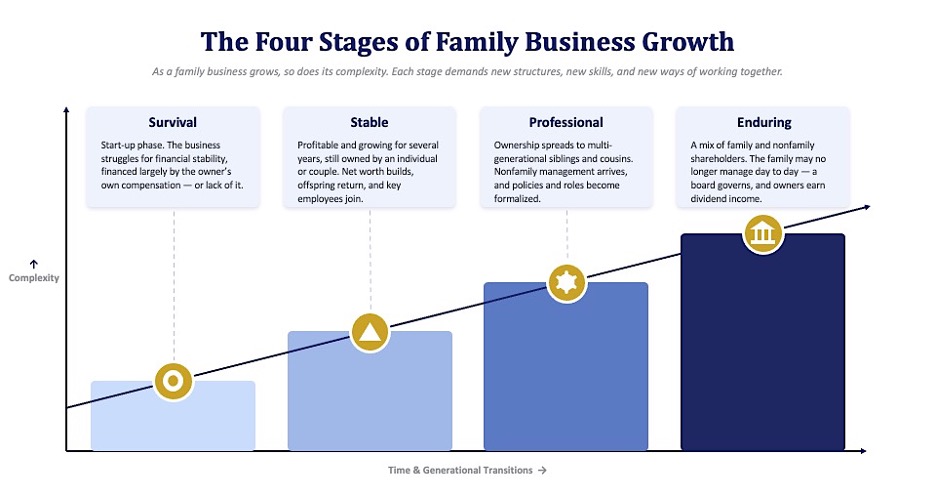
Movement through the stages occurs while the business is growing in size. To be successful at each stage requires new mindsets and skillsets, and perhaps new people with different experiences. And as the size of the business increases, the jobs to be done by the family member-owners become more focused on management and leadership, and less focused on doing the physical labor.
Transitioning a closely held business to the next generation is hard work. Between potential role confusion, the need for different problem-solving approaches and navigating the process of professionalizing the family business, many family-owned businesses struggle to develop a coherent succession plan. It becomes clearer why the Deloitte survey reported only 23% of family business leaders have implemented a plan.
A different approach
Based on 30 years of working with family-owned businesses, I propose a different approach to succession planning: step away from succession as a product to be completed and toward succession planning as an ongoing management process. None of the steps below are a silver bullet. But together, they create a discipline for navigating the adaptive work of transition.
Change the mindset: Succession planning is not a technical activity that experts solve by delivering a static “succession plan.” It is an adaptive challenge that people in the business continually work through. I often describe this as “exercising the succession muscle”: developing the discipline to regularly assess and recalibrate how the business is transitioning. Succession planning is never done.
Commit to communication: After changing the mindset around succession planning, the next step in the process is committing to more frequent communication. Due to the long history of family relationships and the expected level of trust between family members, communication is often lacking. Family members assume their business partners are fine with decisions, that they can talk later or that, based on family culture and expected norms, communication isn’t necessary. And while the high degree of trust within a family may allow for a nimbler and more flexible approach to governance, the reality is that over time, reduced communication erodes trust.
I once mediated a dispute between two brothers who ran different divisions of a family company but shared some employees between the two segments of the business. One brother, without talking it over with his partner, decided to give staff members in “his” division a raise. The brother who gave the raise didn’t think they needed a conversation. His brother would understand the decision. But the employees did talk about it, and staff who didn’t get a raise were upset. It created a conflict between the brothers that in turn put a strain on their relationship, hurting their efforts to keep the business together.
While no one loves the idea of more meetings, business growth and family involvement demand a regular communication cadence. I have seen family businesses make this work through a weekly partner meeting, Saturday morning conference calls or monthly meetings over a meal. The exact format matters less than the commitment to a recurring process. If necessary, ask a trusted advisor, friend or key non-family employee to help hold the family accountable. It’s basic, but necessary.
Make better decisions. Regular communication matters, but the quality of those conversations matters even more. Informal family relationships can allow assumptions to substitute for deliberate decision-making. Because succession is an adaptive challenge, families need a process that helps them surface perspectives, consider alternatives and make decisions together.
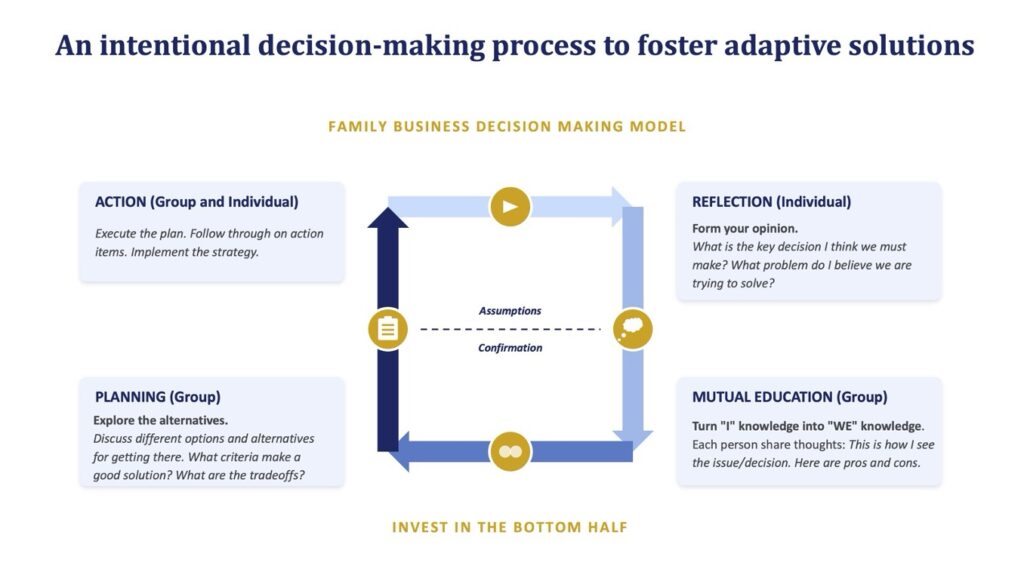
A better decision-making process involves spending more time-sharing perspectives with one another, turning “I knowledge” to “we knowledge.” It means going around the table, asking people to offer their opinions, probing their answers, asking clarifying questions of one another and making sure each person is heard.
A better process also spends enough time exploring options before moving to a decision. An asset purchase, for example, might involve comparing leasing versus buying, used versus new, expected ownership length and the impact on debt structure for working capital.
An estate decision might similarly explore the pros and cons of various legal instruments, the timing of gifts, whether assets should be divided equally or based on involvement in the business, or whether charitable giving should be part of the plan.
The point is to spend more time in conversation, discussing what you could do before deciding what you will do. The Family Business Decision-Making Model makes that discipline visible: sharing perspectives builds “we knowledge,” and exploring options surfaces feelings, concerns and ideas before assumptions harden into decisions. Spending more time-sharing perspectives and exploring options can prevent those assumptions from driving the process.
Vision, Goals, Roles, Skills and Transitions. The decision-making process becomes most useful when families apply it consistently to the core topics of succession. Over the years, I’ve found five topics that repeatedly require deliberate discussion: vision, goals, roles, skills and transitions.
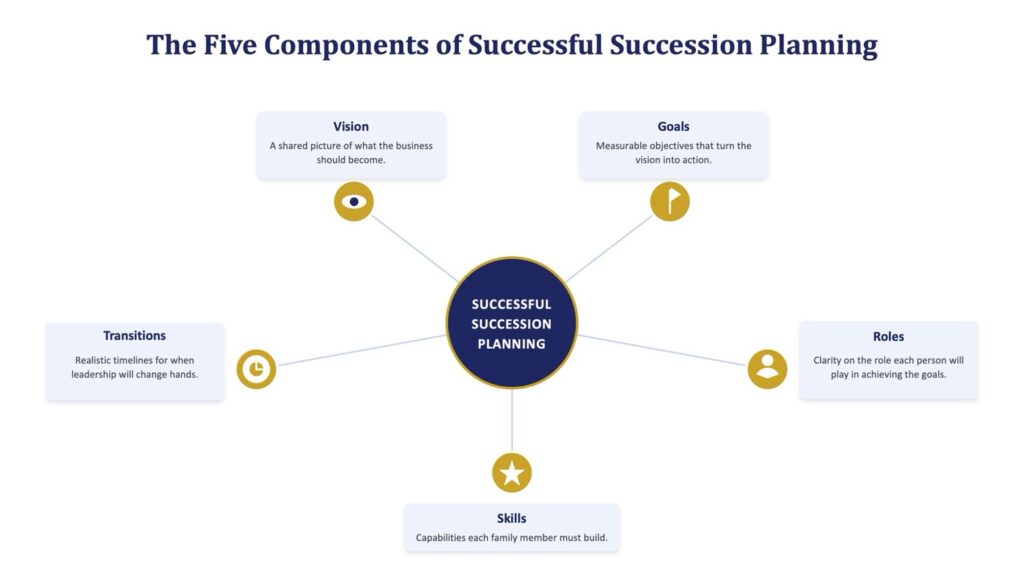
These five topics give the Family Business Decision-Making Model something concrete to work on. Vision and goals are outward facing, giving family business members a sense of direction and milestones indicating progress. Roles, skills and transitions are inward-facing, focusing on each family member’s development. This parallel track turns succession from an occasional planning event into an ongoing management practice.
Revisit your definition of success. My final recommendation for successfully navigating succession planning in a family business is to talk about your family’s definition of success. For many family businesses, a common assumption is that success means the business must transition to the next generation. If the business has been passed down three, four, or more generations, the pressure to “keep it going” is immense.
However, if you pass the business, but lose the family relationships along the way, is the transition truly successful? If you pass a failing business to the next generation, have you really accomplished your goals? Many businesses have been sold, or collaboratively split, so that the family relationships can remain intact, or so that family members can pursue their own goals.
Pursuing alternatives to an intrafamily transition does not indicate failure. Rather, defining success together helps the family evaluate whether its decisions are preserving both the health of the business and the relationships that matter. Revisiting that definition helps family member-owners stay aligned as circumstances change.
Family business transitions are notoriously difficult. Instead of pinning your hopes on a completed succession plan, build a repeatable process for having regular conversations and making the decisions that transition requires. Communicate often, use a deliberate decision-making process, revisit your family’s vision, goals, roles, skills and transitions, and keep asking what success means for both the business and the family. The plan will change. The capacity to plan together is what will make succession more manageable.
About the Center for Food and Agricultural Business
Founded in 1986, the Purdue University Center for Food and Agricultural Business is celebrating 40 years of working with the agribusiness industry to develop leaders and inform better decision-making. Housed within Purdue’s Department of Agricultural Economics, the center connects faculty expertise with the practical challenges facing food and agricultural companies.
The center delivers professional development programs, industry research and graduate education designed specifically for agribusiness professionals. Offerings include open-enrollment workshops, custom corporate training and the MS-MBA in Food and Agribusiness Management, a dual-degree program developed with industry for working professionals.
Through its research and publications – including the Purdue Agribusiness Review – the center shares industry insights from Purdue faculty and collaborators to help agribusiness leaders navigate change and make more informed strategic decisions.