
Reviewers
Dr. Scott Downey, Professor and Director of the Center for Food and Agricultural Business, Purdue University
Chenyu Pan, Graduate Research Assistant, Purdue University
Article
The impact of generative AI technology on B2B sales process and performance: an empirical study by Michael Rodriguez, Dawn Deeter-Schmelz and Michael T. Krush
Source
Rodriguez, M., Deeter-Schmelz, D. R., & Krush, M. T. (2025). “The impact of generative AI technology on B2B sales process and performance: an empirical study.” Journal of Business & Industrial Marketing, 40(10), 2013–2027.
Summary
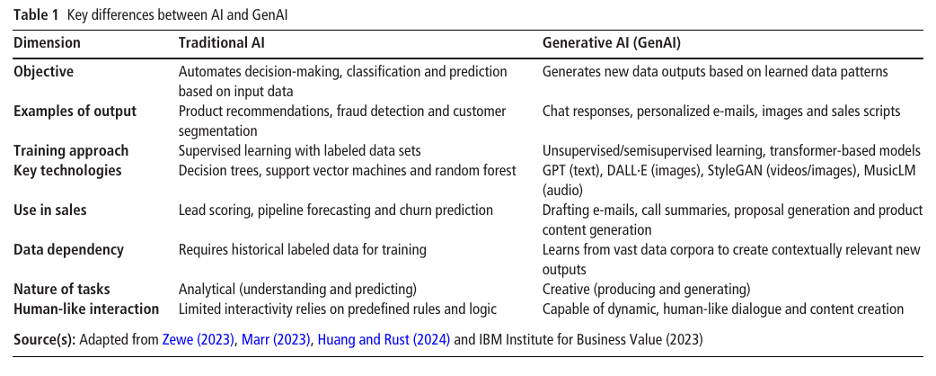
A recent article in the Journal of Business & Industrial Marketing provides one of the first empirical looks at how generative artificial intelligence (GenAI) is reshaping B2B sales. Many agribusiness firms already know about traditional AI tools. They can use these tools for lead scoring, customer segmentation and forecasting. However, the new wave of generative technology works very differently. GenAI such as Salesforce’s Einstein GPT or Microsoft Copilot can produce original content – personalized emails, sales scripts, summaries and proposals – rather than simply analyzing existing data.
Table 1 (below) highlights clear differences and shows why GenAI represents a new capability for sales organizations. For industries focused on relationships and technical selling, like agribusiness, this presents both a chance and a challenge.
The study surveyed sales professionals at a health-care firm already using GenAI in daily operations. Instead of running heavy econometric models, they used a structured survey and an analytical approach to understand how different factors relate to one another. In plain terms, they looked at how strongly managers encouraged AI use, how confident sales reps felt with technology in general, how often those reps actually used GenAI in their day-to-day selling, and finally, what that usage meant for their effectiveness and performance.
Their major findings are interesting. GenAI improved sales conversations, streamlined administrative tasks and improved performance. But what drove adoption wasn’t individual comfort with technology, it was leadership support. Managerial encouragement played the central role in determining whether GenAI became embedded in daily sales work. This marks a fundamental shift from earlier technologies like CRM systems, which often spread because individual reps decided they liked them. GenAI demands organizational buy-in, formal training and cultural support. Leaders who actively use and endorse AI tools help create an environment where adoption becomes natural and beneficial across the salesforce.
Why it matters
The impact of GenAI stretches far beyond simple sales metrics. GenAI automates administrative tasks that have long been a burden for salespeople. This includes reporting, note-taking and proposal writing. It frees them to focus more on selling and building relationships. It can also craft personalized messages, analyze customer interactions and generate follow-up content in seconds. When used well, it turns data into dialogue, enhancing both productivity and customer experience.
At the same time, GenAI is not a plug-and-play solution. Reps need practice in prompting, interpreting AI output and refining drafts. Without leadership support and clear expectations, GenAI risks becoming underutilized or viewed skeptically. As the study shows, technology only works when organizations actively support it.
What does this mean for food and agricultural business?
Agribusiness is a great context for the lessons in this study. Dealers, input suppliers and equipment companies all work in relationship-driven, information-heavy B2B environments. Salespeople often serve as both technical advisors and trusted partners. They cover large territories and a diverse customer base. In this setting, GenAI can change how value is created in several important ways.
Most obviously, GenAI provides significant efficiency gains. Tools that create customer reports, summarize notes, write follow-up messages, or update CRM systems can free up hours of administrative work for salespeople each week. In an industry with narrow margins and constant travel, regaining that time for conversations with growers is a clear advantage. It also allows for more personalization. A seed dealer can quickly summarize local trial data, customize recommendations to a producer’s acreage and cropping mix, or prepare follow-ups that directly address yield goals and risk factors. These tasks once required considerable manual effort but can now be completed in minutes at scale.
But the most important insight for agribusiness mirrors the study’s core finding: leadership determines adoption.
Agricultural input suppliers often have sales teams with different levels of digital skills and comfort with new tools. Leaders who model GenAI use, provide hands-on training and encourage experimentation see faster, more confident adoption – even among reps who are less tech-oriented. For agribusiness firms, it’s not enough to buy AI tools; leaders must show their value, integrate them into onboarding and workflow expectations and emphasize early successes to build confidence within the team.
Preparing an organization for GenAI requires a clear plan. Leaders should:
- Demonstrate how they use GenAI in planning, communication and reporting
- Invest in teaching prompting skills so representatives can get reliable, high-quality results
- Integrate GenAI into CRM, ERP or digital agronomy platforms
- Encourage small-scale experimentation so early adopters become internal champions
Beyond sales, GenAI aligns with longstanding themes in agricultural economics. By reducing information gaps between suppliers and producers, these tools could improve transparency and market efficiency. Over time, they may change transaction costs, workforce needs and even bargaining power across the supply chain. It also raises new questions about trust, data ownership and governance – critical considerations in a relationship-based sector.
Farmers will want to know who owns the data behind AI-generated recommendations, how those recommendations are created and if the human relationships at still at the core of their business. These are behavioral and institutional considerations, not just technological ones, and align closely with the study’s conclusion that confidence and leadership drive successful adoption.