

Reviewers
Gustavo Stevanin de Souza, Graduate Research Assistant, Purdue University
Masie Keshavarz, Senior Research Project Manager, Purdue University
Article
Safer to plant corn and soybeans? Navigating the challenges and opportunities of agricultural diversification in the U.S. Corn Belt
Source
Traldi, R., Asprooth, L., M. Usher, E. et al. “Safer to plant corn and beans”? Navigating the challenges and opportunities of agricultural diversification in the U.S. Corn Belt. Agric Hum Values 41, 1687–1706 (2024). https://doi.org/10.1007/s10460-024-10570-7
Summary
In 2024, researchers examined the deep-rooted nature of industrialized agriculture in the U.S. Corn Belt and what makes diversification both appealing and difficult for farmers in the region. While specialization has brought efficiency and strong economic returns, it also comes with well-documented trade-offs: loss of biodiversity, soil and water challenges and high barriers to entry for new farmers.
The authors propose that agricultural diversification, which includes extended crop rotations, livestock integration, agroforestry and other practices, could offer a pathway toward greater socioeconomic and environmental resilience. The study aimed to understand how farmers perceive both the benefits and challenges of diversification, and how those perceptions influence realistic pathways to change.
Researchers conducted 20 focus groups with 100 producers across Indiana, Illinois and Iowa between April 2022 and February 2023. They intentionally included both:
- Less diversified farmers (corn and soybeans only)
- Diversified farmers (three or more crops, livestock or alternative markets)
Using an interpretive grounded theory approach (Corbin and Strauss, 1990; Sebastian 2019), the authors analyzed the focus group transcripts to identify recurring themes regarding economics, policy constraints, labor dynamics and social norms.
Why the corn-soybean system remains dominant
Farmers consistently described the current system as a “plug-and-play” model: efficient, low risk and supported by an extensive infrastructure of agribusiness retailers, input suppliers, machinery and agronomic advice built specifically for corn and soybeans. Policies like subsidized crop insurance and mandates like the Renewable Fuel Standard further reinforce this structure.
The authors describe this as a “lock-in” effect: external forces that make the specialized system the most rational economic choice.
However, this stability comes with trade-offs. Farmers also recognized drawbacks:
- A loss of autonomy within a tightly structured system
- High land costs that squeeze out young or beginning farmers
- A relentless focus on yield (bushels/acre) that can overshadow soil health and long- profitability
Many participants voiced growing concern that the current system may limit future resilience.
Barriers and benefits of diversification
When discussing diversification, farmers identified systemic hurdles that make breaking away from the corn and soybeans cycle financially and logistically dangerous.
- Economic uncertainty. Alternative crops often lack reliable local markets and processing infrastructure.
- Labor and complexity. Diversified systems require more management, more specialized knowledge, and often more labor.
- Policy misalignment. Existing insurance programs rarely fit diversified operations.
- Social pressure. A “clean” cornfield remains a status symbol; experimentation can attract skepticism from neighbors.
Yet the study also revealed significant motivation to diversify.
Farmers who had already diversified described it not simply as a production choice, but as a “survivability feature.” They cited:
- New and more resilient revenue streams, such as direct-to-consumer markets
- Strong performance during the COVID-19 supply-chain shocks
- Increased personal satisfaction and creativity
- Opportunities to involve family members in new enterprises (e.g., pastured poultry, vegetable crops)
These producers viewed obstacles – labor intensity and market access – not as dead ends but as areas for innovation and investment.
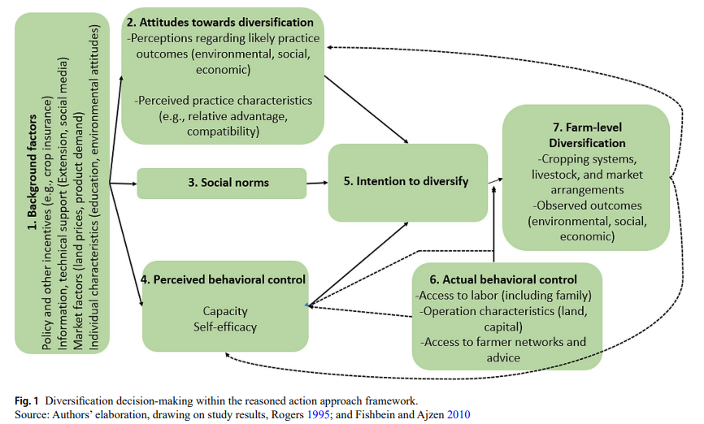
These findings align well with the Reasoned Action Approach (Fishbein and Ajzen; 2010) and Diffusion of Innovation Theory (Rogers, 1995), suggesting that positive changes are driven by shifts in attitudes, social norms and perceived support. When farmers see peers succeeding and feel supported by markets and policy, the social norms that discourage diversification can shift.
Implications for agribusiness
The research offers important strategic signals for agribusiness firms serving the U.S. Corn Belt. While specialization remains economically dominant, interest in diversification is rising, and represents future demand and opportunity.
- De-risking diversification
Agribusiness firms can play a catalytic role in lowering the risk for farmers by:
- Building supply chains for small grains and alternative crops
- Developing contracting programs, aggregation points, and value-added processing
- Offering specialized agronomic support, equipment packages or integrated crop-livestock or perennial systems
- Collaborate with lenders and insurers on financial tools tailored to diversified operations.
- Serving emerging market segments
A distinct segment of younger, innovation-driven producers is exploring regenerative systems, organic transitions and direct-to-consumer markets. Agribusiness firms can respond by
- Designing product lines and advisory services suited to diversified systems
- Supporting specialty seed, small-scale machinery and multi-species grazing
- Creating peer learning networks or demonstration sites to build brand loyalty and trust
- Rethinking the value proposition
Farmers described the existing corn-soybean ecosystem as convenient, standardized and risk-reducing. They also perceive it as limiting, homogenizing and constraining to their autonomy. Agribusiness retailers may need to shift from transactional input suppliers to whole-farm systems partner. That includes complex, cross-enterprise technical advice, as well as more advanced diagnostic tools and decision-support platforms.
- Strategic policy advocacy
Diversification is significantly constrained by crop insurance, conservation program design and infrastructure gaps. Agribusiness companies that rely on a strong, resilient customer base may find strategic value in advocating for more flexible insurance programs that accommodate alternative crops or mixed systems. Supporting cost-share programs, pilot projects, or public–private partnerships that enable experimentation is another avenue for engagement. Ultimately, influencing policy frameworks to align producer incentives with long-term soil health, water quality and climate adaptation will help secure a more stable future for the entire industry.