Periods of volatility in agriculture are nothing new. Input costs shift, weather remains unpredictable, global markets send mixed signals and producers face increasingly complex decisions. But when pressure builds, one truth becomes even clearer: organizations that outperform are the ones whose people are equipped to adapt, communicate and move strategy forward.
Yet when markets tighten, training and development are often the first investments pulled back.
At Purdue’s Center for Food and Agricultural Business, we see something different. Across our work with agribusiness companies, retailers, and cooperatives, the organizations that continue to invest intentionally in their people during challenging periods strengthen capability, protect customer relationships and position themselves for faster growth when conditions improve.
That belief sits at the core of our custom programming and our structured 5-D process we use to build it.
Why now is the time to invest (even when margins are tight)
Customers need more help, not less.
When markets fluctuate, producers rely on advisors who can help them evaluate trade-offs, frame risk and make better decisions. Training isn’t a luxury in these moments. It’s a strategic capability.
Your constraints are real, and your people can help navigate them.
When margins tighten, companies feel the squeeze on time, budgets, knowledge and people. These constraints shape everything we do in the early stages of program design. The question becomes: How can your team work differently to make progress within those constraints?
Teams that learn through the downturn drive the upswing.
Research consistently shows that companies maintaining capability development during economic stress outperform those that pause. Developing your people builds resilience, sharpens execution and improves innovation, which is exactly what agribusinesses need during these times.
The 5-D Process: How we support capability building
While many organizations see training as a one-time event, we view learning as a strategic journey. Our 5-D process – Discover, Design, Develop, Deliver, Drive – helps partners align development efforts with business goals, constraints and customer needs.
Purdue's 5-D Approach
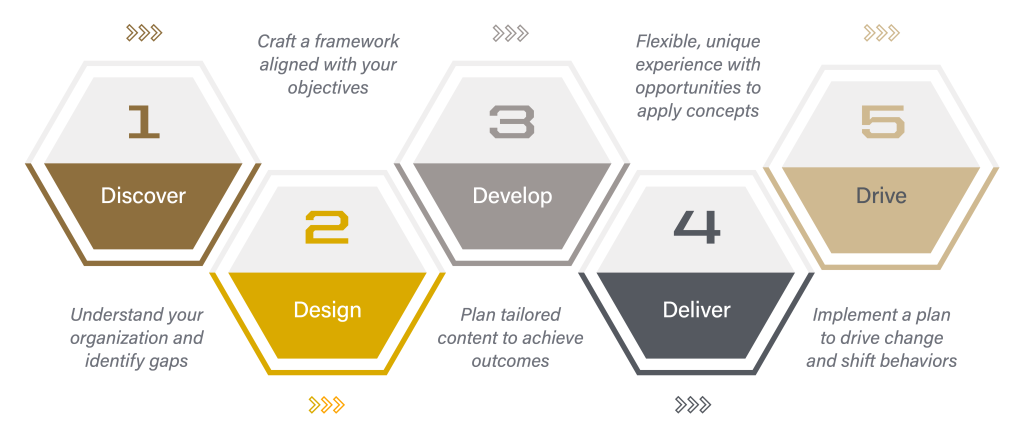
This blog highlights the two bookend stages that matter most during economic uncertainty: Discover and Drive.
Discover: Getting clear on what matters most
Discovery is where clarity happens. It’s where we work with leaders to understand what’s shifting in the business and what the team needs to do differently to support that direction.
This phase focuses on the big questions that often get overlooked in day-to-day execution:
- Where are we now?
- Where do we want to be?
- What will it take – across time, money, knowledge and people – to get there?
- What capabilities must our teams build to support that movement?
Discovery aligns the development effort with real organizational priorities. It ensures the program is built around what will actually make a difference – not what simply sounds good on paper.
Most importantly, it creates a shared understanding among leaders before training ever begins. That alignment is what turns development into part of strategy execution, not a standalone activity.
Drive: Turning learning into behavior
Learning only creates value when it shows up in the way people work. Drive focuses on what happens after the learning experience – how participants apply new concepts, how leaders reinforce behaviors and how the organization measures whether development is making an impact.
Drive is centered around each person’s journey. It considers:
- What will application look like in different roles?
- How will leaders support and model the behaviors they want to see?
- What mechanisms or touchpoints will help learning stick?
This stage becomes the bridge between “we learned it” and “we do it consistently.” In a low-margin, high-volatility environment, performance and consistency matters.
Where agribusiness leaders should focus when budgets are tight
When budgets are tight, the highest-impact investments become clearer:
- Prioritize roles closest to the customer. Advisors, managers, and front-line teams shape producer confidence and loyalty.
- Invest in capabilities that move business outcomes. Margin management, account planning, pricing conversations, risk framing, leadership alignment – skills that support both the current environment and long-term strategy.
- Treat development as part of strategy execution. Not a perk. Not a one-time event. A core component of how the organization responds to volatility with confidence and clarity when the market shifts.
CAB’s custom programming and 5-D process help companies translate strategy into the everyday behaviors required to deliver it, especially when conditions are challenging.
A final word to leaders navigating uncertainty
Economic cycles come and go, but capability endures. When organizations choose to invest in their people during challenging times, they build the resilience, clarity and cohesion needed not to endure difficulty and come out ahead.
At CAB, our mission is to help agribusiness organizations strengthen those capabilities through strategy-aligned, learner-centered custom programs grounded in the 5-D process.
If your team is preparing to navigate tighter markets, shifting customer expectations or significant strategic change, we’re ready to support your next step.