

About LCP Signals
A blog series from Purdue University’s Center for Food and Agricultural Business exploring early insights from the Large Commercial Producer Survey
As part of the release of the Large Commercial Producer (LCP) Survey, this blog series highlights a set of early signals emerging from the data. Rather than presenting full findings, each piece focuses on a specific question, tension or pattern and offers perspective on what it may mean for producers and the broader agribusiness industry.
These short, insight-oriented posts are designed to spark curiosity, raise new questions and begin the conversation ahead of the full themes report.
Are large producers really data-driven?
As we prepare to release this year’s LCP survey findings, one question keeps resurfacing. In an industry that talks constantly about data, dashboards, and analytics, how are large commercial producers actually making decisions?
We asked producers to place themselves on a 1–9 scale – where 1 represents intuitive decision-making and 9 represents analytical decision-making – when purchasing most farm inputs. The results don’t tell a simple story. Instead, they reveal a tension that feels increasingly relevant for agribusiness leaders.
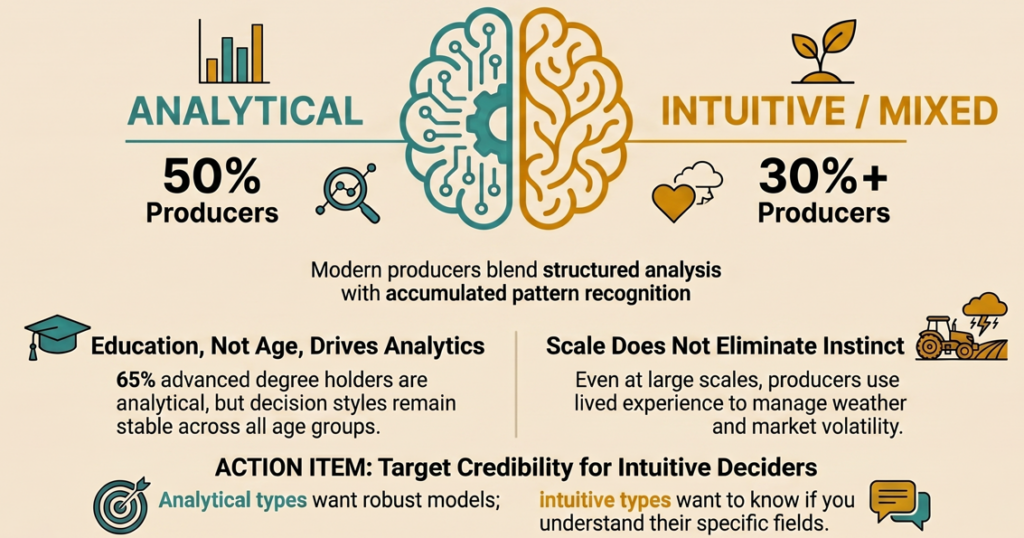
Nearly half of primarily crop producers (48.3%) and more than half of primarily livestock producers (53.6%) identify as primarily analytical decision-makers. At first glance, that seems to confirm the dominant narrative: large producers are data-driven. But that’s only half the story. Roughly one-third of producers – 32.9% in crop and 29.5% in livestock – fall into the intuitive category. Add the “mixed” segment, and something becomes clear. Analytical thinking may be the largest single group, but it is far from universal. The modern commercial producer is navigating between instinct and analysis.
A subtle but important tension
The most obvious signal is the size of the analytical segment. But what’s more interesting is what it does not show. If this were a fully data-driven environment, we might expect 70–80% of producers to identify as analytical. Instead, analytical decision-makers represent just under half of crop producers and just over half of livestock. That means a substantial portion of the industry continues to rely meaningfully on experience, intuition and judgment – particularly in crop systems.
Why might that be? Agriculture is inherently uncertain. Weather volatility, biological variability, shifting markets and policy dynamics complicate even the most robust datasets. In such environments, intuition is not the opposite of sophistication. It is accumulated pattern recognition.
As technology providers, retailers and input manufacturers push increasingly data-centric value propositions, are they overestimating how dominant analytical decision styles truly are?
What shapes how producers decide?
One of the clearest gradients in the data appears across education levels. Among crop producers with advanced degrees, 65% identify as analytical. That number drops to 38% among those with other education levels. A similar pattern appears in livestock operations. This suggests that exposure to formal analytical frameworks – whether through higher education, professional training or extended engagement with complex systems – correlates strongly with self-described decision style.
What’s striking is what doesn’t show up as clearly: age. Analytical thinking remains relatively stable across age groups in both crop and livestock sectors. That challenges a common industry assumption that younger producers are inherently more data-driven.
The data hint at something more nuanced. Decision style may be shaped less by generation and more by training, exposure and system complexity. For agribusiness leaders, that raises an important question: Are we segmenting our messaging by age when we should be by decision style?
Farm scale doesn't simplify the story
We might expect larger farms to skew decisively analytical. After all, complexity increases with scale. And while analytical thinking does remain strong among large operations – particularly in livestock – intuitive decision-making does not disappear. In fact, intuitive shares in large crop operations remain meaningful.
This complicates another common narrative: that scale inevitably drives data dependence. Instead, it suggests that even at scale, producers are blending structured analysis with lived experience. That integration may be the real hallmark of large commercial operators.
What’s striking is what doesn’t show up as clearly: age. Analytical thinking remains relatively stable across age groups in both crop and livestock sectors. That challenges a common industry assumption that younger producers are inherently more data-driven.
The data hint at something more nuanced. Decision style may be shaped less by generation and more by training, exposure and system complexity. For agribusiness leaders, that raises an important question: Are we segmenting our messaging by age when we should be by decision style?
Why this matters now
The industry is moving fast. Precision technologies, subscription models, bundled offerings, biological inputs, sustainability metrics, performance guarantees – nearly every major innovation in agribusiness is is framed in analytical language. Predictive ROI models. Optimization dashboards. Risk-adjusted projections.
That framing makes sense for roughly half the market. But the LCP data are a reminder that the other half is still in the room. If roughly one-third of producers lean intuitive, and many more operate in a mixed space, then a purely analytical pitch may be landing on deaf ears more often than the industry assumes. Intuitive decision-makers aren’t evaluating your model. They’re evaluating your credibility. Your flexibility. Whether the person behind the recommendation actually stood in a field like theirs.
Analytical decision-makers want to know what assumptions drive the model, and how it holds up against alternative scenarios. Intuitive ones want to know whether it fits how they actually run their operation, and whether they trust the people recommending it.
Both questions deserve a real answer. And the data suggest neither is going away.
The deeper question for agribusiness leaders
It would be easy to read this data as a transition story – intuition giving way to analysis as farms scale and systems digitize. But that’s probably not what’s happening. The more honest reading is that the most effective large producers aren’t abandoning instinct. They’re refining it through data. Analytics aren’t replacing their judgment. They’re informing it.
That distinction matters strategically. It means the next wave of agribusiness positioning may need to move beyond “data-driven transformation” as a default storyline – and start asking harder questions.
Are we designing products and services that speak to both structured analysis and accumulated experience? Are we segmenting our messaging by age when the real variable is decision style? Do our sales conversations acknowledge that a producer with 30 years of pattern recognition is exercising a form of expertise – not resisting progress?
These aren’t soft questions. They shape adoption rates, loyalty and the kind of long-term relationships that actually drive value. The LCP data might not resolve the tension between intuition and analysis in agricultural decision-making. But it makes it harder to pretend that tension doesn’t exist.