Agribusiness sales are not a rural variant of conventional B2B commerce. It operates under its own structural logic and performance drivers. The sooner we build management systems that reflect that reality, the better positioned our firms will be.
Here’s the finding that surprises most people: agribusiness salespeople devoted only 9.3% of their selling time to closing, compared to 12.8% for peers in manufacturing, healthcare and finance. In a market where purchase decisions are tied to planting season and a production cycle that plays out over an entire year, aggressive closing is ineffective and the wrong tool entirely.
That’s one of the central findings from a study just published in the Journal of Business-to-Business Marketing, in which my co-authors Scott Downey, Zanliang Meng and I analyzed data from the largest comparative dataset of agribusiness salespeople ever assembled. The data confirm what experienced practitioners have long sensed but rarely had numbers for: agribusiness selling is structurally different and managing it like generic B2B is costing firms.
We call it business-to-farm (B2F) selling, a commercial context so distinct from conventional B2B markets that it deserves its own framework, its own metrics and its own research tradition.
The numbers
Agribusiness salespeople spend significantly more time on relationship-building (23.4% vs. 17.9%), information-gathering (17.3% vs. 15.1%), and post-sale service and follow-up (15.1% vs. 13.4%) than their peers in other industries. They spend considerably less time prospecting, pitching products, handling objections and closing.
The structural reason matters. Farms are typically owner-operated, purchase decisions are concentrated in one or two people and a bad input choice ripples through an entire growing season. In that environment, trust is a condition of market access. Salespeople who don’t understand that tend to wash out.
Four types of agribusiness salespeople
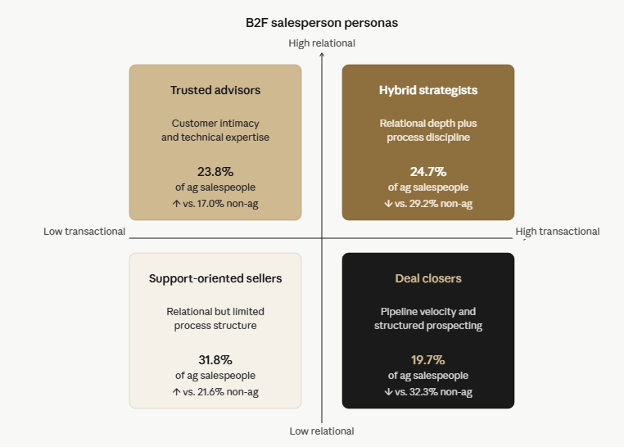
Beyond the time allocation, we used factor analysis to classify salespeople into four personas based on their relational and transactional orientations:
Hybrid Strategists combine deep customer relationships with structured sales discipline. They’re best suited for complex accounts that demand both.
Trusted Advisors lead with customer intimacy and technical expertise. Picture a rep who opens a farm call not with a product pitch but with questions about last season’s yield data and what’s worrying the grower this year. They’re overrepresented in agribusiness relative to other industries…and for good reason.
Deal Closers emphasize prospecting and pipeline velocity. They’re significantly underrepresented in agribusiness (19.7% vs. 32.3% in other sectors). The market is telling us something.
Support-Oriented Sellers prioritize relationships but lack the transactional structure to fully leverage them. They’re the most common persona in agribusiness at 31.8%, suggesting a meaningful coaching and development opportunity for sales managers.
What this means for sales managers
If you’re evaluating your agribusiness sales team using closing ratios and pipeline velocity, you’re likely measuring an incomplete set of things. The activities most predictive of success in farm-facing markets are relationship quality, technical credibility and post-sale service. Those don’t show up cleanly in a CRM dashboard.
Training programs that import generic objection-handling and closing curricula from other industries may also be missing the point. The skills that matter in business-to-farm selling are diagnostic listening, consultative problem framing, and the ability to translate complex agronomic or market data into recommendations a farmer can act on. Those take longer to build and are harder to measure, but they’re what the data says actually drives the work.
The full study, “What Makes Business-to-Farm Sales Distinct? Evidence from Time Allocation and Salesperson Personas,” is available open access in the Journal of Business-to-Business Marketing. Data are available upon request.